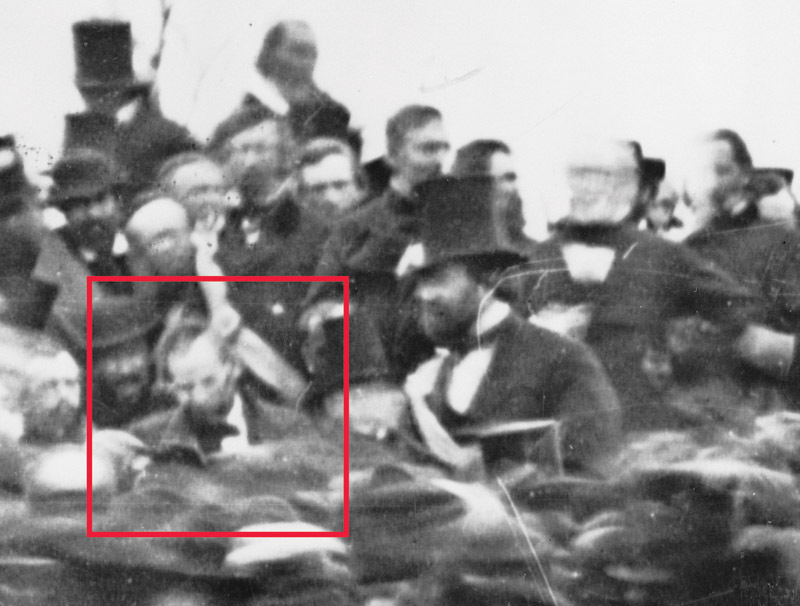
Today is the 150th anniversary of the Gettysburg Address.
Lincoln casts quite a shadow in history. There was a grand speech before Lincoln's at Gettysburg in 1863 by Edward Everett, a well-known orator.
Speaking for 2 hours and over 13,000 words Everett's speech was complex, referencing Ancient Greece and using terms in Latin. Today Everett's speech is largely "invisible."
Lincoln spoke only for 2 minutes, and his 272 words are inscribed on the Lincoln Memorial.
Apple - Making the Mac Pro (2013)
I love videos like this, especially the “How it’s Made” series on the Discovery science channel.
The robotic ballet is mesmerizing, and it’s great that the new Mac Pro is assembled in the United States. With the complexity of the global marketplace, it seems unlikely that new high-tech devices could also be completely manufactured in the US though.
Google is producing the Motorola Moto X smartphone in the US too.
Murlyn Hakon of Bletchley Park explains how the Enigma Machine worked.
The remarkable thing about Enigma, is that when you press a letter on the keyboard and the subsequent enciphered letter lights up to the rear of the machine, the chances of that letter lighting up are nearly 158 million million million to 1.
(Revised and republished April 21st, 2025)
Mavis Batey was one of the codebreakers working at Bletchley Park during World War II. She recently passed away at age 92. Batey was part of the codebreaking team that ensured a successful landing for Allied forces on D-Day.
She initially worked in London, checking commercial codes and perusing the personal columns of The Times for coded spy messages. After showing promise, she was plucked out and sent to Bletchley to work in the research unit run by Dilly Knox.
Horror film legend George Romero on zombies:
I always used the zombie as a character for satire or a political criticism…
I think the zombies could be anything. They could be a hurricane or a tornado. It’s not about the zombies. The important thing to me is the way the people react to this horrible situation, misbehave, make mistakes and screw themselves up.
George A. Romero interview: “The Walking Dead is just a soap opera with the occasional zombie” (Wayback Machine link)
Google, NASA, and D-Wave are teaming up to take quantum computing to the next level.
The case or container of the D-Wave is much more empty than I had suspected. It’s so different from portable computing which seeks to maximize internal dimensions for power usage and heat.
The biggest question is the question itself – “we don’t know what the best questions are to ask that computer, that’s exactly what we’re trying to understand now” (Eleanor Rieffel @ 4:52 in the video above).
Quantum Computers Animated, Piled Higher and Deeper (PHD Comics)
The illustrations for this video on quantum computing are fantastic, especially the “0/1” transition at 1:40.
(via Hacker News)
(Revised and republished April 19th, 2025)
In a previous post I wrote about
the experience of teaching an online class as a TA. One of the primary tools we used for the course was
Piazza, and it was instrumental in shifting the burden of email to a more open and constructive arena.
On July 22nd, 2013, the American Historical Association published to their blog
a statement regarding the embargo of dissertations (Wayback Machine link). The suggestion was for digital embargo periods to be lengthened from around 1-3 years to 6 years, so that new PhD graduates could revise their dissertation manuscript for the purpose of creating a book for publication. As a significant revision of the dissertation, this book would then become a major component within the process of applying for tenure.
In
"Who is Driving the Online Locomotive," (Wayback Machine link) Rob Jenkins asks some pertinent questions about the force and direction of online education. There is definitely the feeling that something is coming, and those who aren't prepared will be lost by the wayside...or flattened by the train. However, this feeling of online education as the next-big-thing has been palpable for a couple of decades now. The latest gust of wind in the sails has been the infamous MOOC, but it's really more about the intersection of budget cuts and the ubiquity of social networking. It's also very unfortunate that there is usually little discussion of the differences between types of online classes – a MOOC with thousands of participants is a very different thing from a small online-class of 40 students.
A few days ago I finished grading for an online summer class, The History of Latin America (HIST75V). I was the TA (teaching assistant) for Professor Juliette Levy, and this was the first time that either of us had conducted an online course. We’ve both taught the traditional in-class version of this course many times, and the opportunity to transform our in-class materials and teaching styles into an online presence was quite exciting. Professor Levy and I are both from the University of California, Riverside, and the course itself was hosted through
UC Online. This class was an accelerated summer course, only 3 weeks long, and the LMS (Learning Management System) was
Canvas. We also used
Piazza for a student question & answer forum (I’ll write
more about Piazza in another post).
Unintentional Hipster Faculty (Wayback Machine link)
Making a nice-looking Web page is just too hard. The physicists across the street are teleporting matter! But yesterday I had to read a tutorial on how to vertically center an image.
(Revised and republished April 21st, 2025)
Please join us for the Year-End Colloquium for Graduate Students in “BAM.” Designated Emphasis in Book, Archive, and Manuscript Studies –
http://bam.ucr.edu (Wayback Machine link)
Friday, June 7, 2013. 10:00am to Noon
English Department Conference Room (HMNSS 2212)
Presentations by Steve Anderson, Cori Knight, and Heather Van Mouwerik
Display of printshop projects by Rebecca Addicks, Ann Garascia, Cori Knight, Jessica Roberson, and Anne Sullivan
This will also be a celebration of the new Mellon Workshop Grant awarded to the Material Cultures of the Book Working Group – http://bookhistory.
Cindy Keefer, Archivist, Curator & Director . Center for Visual Music
Preserving Visual Music : The Archives of the Center for Visual Music
THURSDAY . May 30, 2013 . 4:30 PM . INTN 1113 . Refreshments served .
Cindy Keefer, Director of the Center for Visual Music Los Angeles, will discuss and screen work by pioneers of kinetic art, abstract animation and pre-digital cinema from CVM’s archives. CVM is a Los Angeles archive dedicated to visual music, experimental animation and abstract media.
Google Buys a Quantum Computer
Google did not say how it might deploy a quantum computer into its existing global network of computer-intensive data centers, which are among the world’s largest. D-Wave, however, intends eventually for its quantum machine to hook into cloud computing systems, doing the exceptionally hard problems that can then be finished off by regular servers.
It’s not very interesting on the exterior, just another black box – actually I wonder if there’s even a computer inside the black monolith in the image below.
UCR ARTSblock presents the exhibition:
Geographies of Detention: From Guantánamo to the Golden Gulag
June 1 – September 7, 2013*
California Museum of Photography, UCR ARTSblock
If It Ain’t Broke, Don’t Fix It: Ancient Computers in Use Today (Wayback Machine link)
Companies traditionally used the 402 for accounting, since the machine could take a long list of numbers, add them up, and print a detailed written report. In a sense, you could consider it a 3000-pound spreadsheet machine. That’s exactly how Sparkler Filters uses its IBM 402, which could very well be the last fully operational 402 on the planet.
TaB soda was named by an IBM mainframe (Wayback Machine link) – now it makes sense. The name was supposed to relate to keeping “tabs” on your weight (Wayback Machine link), rather than being an acronym for “totally artificial beverage.”
To obtain a list of potential names, William Mannen, chief programmer for data processing, programmed the company’s IBM 1401 (Wayback Machine link) mainframe computer to print all possible four-letter word combinations containing a vowel or vowel-sounding letter.