artificial intelligence
"Too large for humans alone"
(5:42) Multiple AIs working with multiple humans, each contributing what the others couldn't. That's not 'AI solves math problem.' That's a new way of doing science. And if it works for Graph Theory, it works for drug discovery, for material science, for any field where the search space is too large for humans alone, and too structured for brute force.
Don Knuth’s paper, “Claude’s Cycles” (published February 28, 2026).
"We're at a fork in the road"
How to spot fake AI photos | Hany Farid | TED April 2025
(8:20) I think this image is a bit of a metaphor for how a lot of us feel. We feel like hostages. We don't know what to trust anymore. We don't know what is real. What is fake. But we don't have to be hostages. We don't have to succumb to the worst human instincts that pollute our online communities. We have agency, and we can effect change.
(11:02) We're at a fork in the road. One path, we can keep doing what we've been doing for 20 years, allowing technology to rip us apart as a society, sowing distrust, hate, intolerance. Or we can change paths. We can find a new way to leverage the power of technology to work for us and with us, and not against us. That choice is entirely ours.
Robot costumes
An article on Vox, This is AI's Actual Endgame, (Apple News) referenced the person-in-a-robot-suit demo at Tesla in 2021:
It’s still embarrassing to watch the part of the Tesla AI Day presentation in 2021 when a human person dressed in a robot costume appears on stage dancing to dubstep music.
Dubstep, awesome! People in robot costumes, representing a company about to make robots, not so much.
And I don't think that was dubstep either.
Yep, Shazam tells me it's Destroying Teams by Hotschedules.
Her, HAL, glaze, and vanilla
Some notes on personality changes in OpenAI’s ChatGPT:
Regarding the “her” tweet for GPT-4o, or whatever a post in X is:
Some users may be repelled by them. But many will come to love and appreciate the new breed of A.I. assistants — and some will inevitably fall in love, as Theodore does.
May 14, 2024 - The New York Times, A.I.'s 'Her' Era Has Arrived
On the backlash of GPT-5, now more HAL than Her:
For others, though, the loss felt personal. They developed an affinity for the GPT-4o persona, or the o3 persona, and suddenly felt bereft. That the loss came without warning, and with seemingly no recourse, only worsened the sting.
August 11, 2025 - Platformer, Three big lessons from the GPT-5 backlash
On GPT-5.1:
The release follows complaints earlier this year that its previous models were excessively cheerful and sycophantic, along with an opposing controversy among users over how OpenAI modified the default GPT-5 output style after several suicide lawsuits.
...the company is offering eight preset options, including Professional, Friendly, Candid, Quirky, Efficient, Cynical, and Nerdy, alongside a Default setting.
November 12, 2025 - Ars Technica, OpenAI walks a tricky tightrope with GPT-5.1’s eight new personalities
The GPT-5.1 Efficient setting seems to be the most HAL-esque:
...which is just tell me what you want to tell me. And you don't have to pretend you're being nice to me. You don't have to compliment me.
November 18, 2025 - Dan Frommer on The Talk Show with John Gruber podcast, #434: 'Knee-Jerk Contrarian,' with Dan Frommer (1:21:45)
There seems to be a consistent problem with “glaze." It seems, though, that glaze is a purposeful attribute – the problem isn’t that there is glaze, it’s that it glazes “too much.”
Dan Frommer also mentions in the podcast (1:25:43), “I try to use the default settings for almost everything, just so I feel like I’m experiencing technology the way that, like, most people are experiencing it.” And I agree, the default setting, the vanilla, can be really interesting. Vanilla might seem basic, but it’s a very difficult thing to do just right.
Shudder at "AI" in 1964
Many researchers shudder at the phrase “artificial intelligence.” Its anthropomorphic overtones, they say, often arouse irrelevant emotional responses – i.e., in people who think it sacrilegious to try to imitate the brain.1


-
Gilbert Burck, “Will the Computer Outwit Man?”, The Boundless Age of the Computer, Part VI, Fortune, Vol. LXX, No. 4, October 1964. Quote in footnote on page 120. Cartoon on page 121 by Nicholas Solovioff. ↩︎
AI slop
John Oliver on Last Week Tonight regarding AI slop.
“AI slop is basically the newest iteration of spam.” (3:26)
“It’s not just that we can get fooled by fake stuff, it’s that the very existence of it then empowers bad actors to dismiss real videos and images as fake. It’s an idea called the liar’s dividend.” (24:33)
“AI slop can be…worryingly corrosive to the general concept of objective reality.” (25:46)
Siri in 1967?
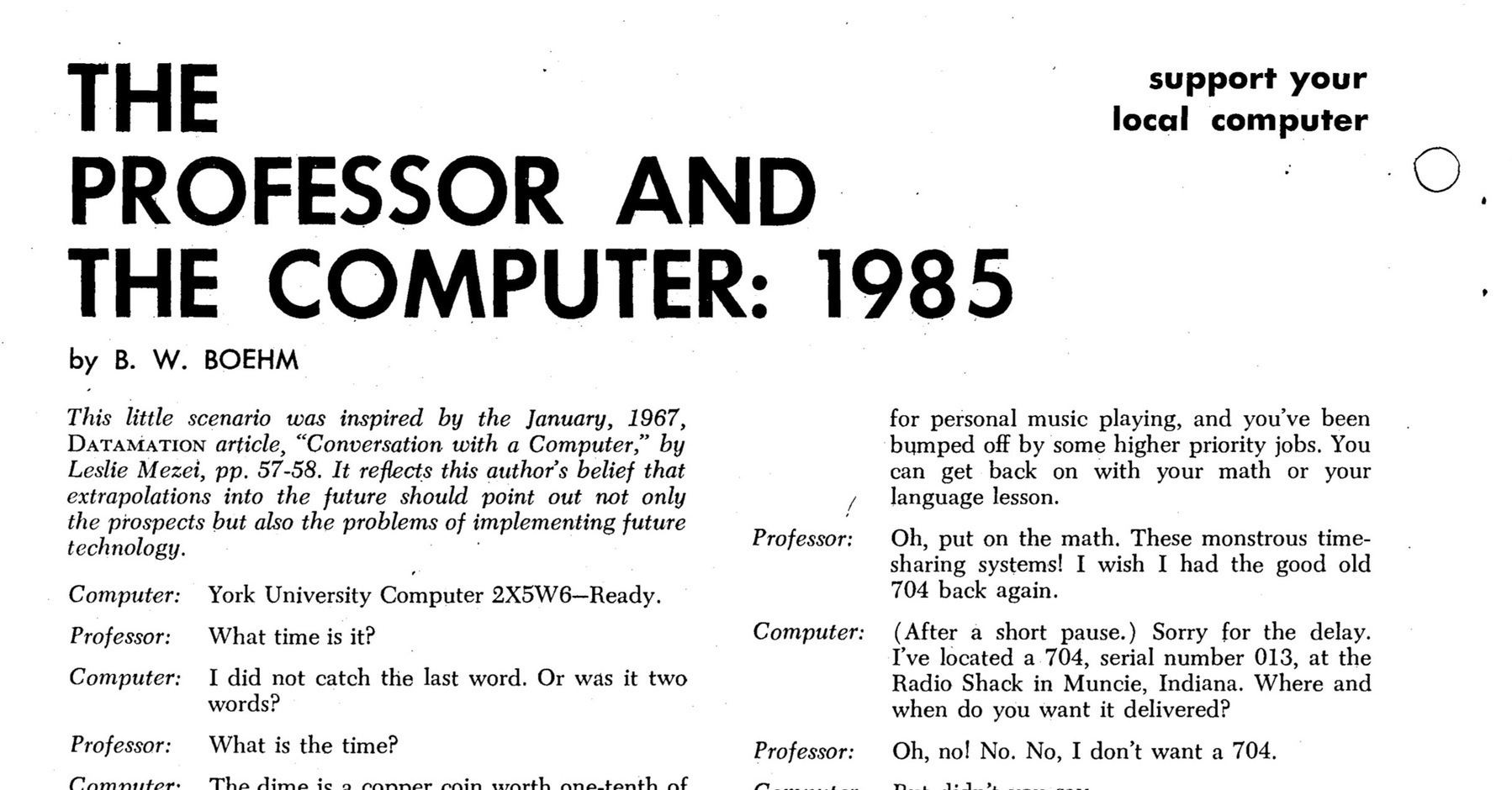
“The Professor and the Computer: 1985,” from Datamation magazine, August 1967 (pp. 56, 58).
This back-and-forth reminds me of the current state of Apple’s Siri, here in 2005…sorry, 2025.
Professor: Oh, put on the math. These monstrous time-sharing systems! I wish I had the good old 704 back again.
Computer: (After a short pause.) Sorry for the delay. I've located a 704, serial number 013, at the Radio Shack in Muncie, Indiana. Where and when do you want it delivered?
Professor: Oh, no! No. No, I don't want a 704.
Computer: But didn't you say ...
Professor: Never mind what I just said. I ...
Computer: Okay, I'll disregard your statement just previous. Now, where do you want your 704 delivered?
The notion that the computer would place an order for another computer, an IBM 704, also reminds me of Amazon’s AI-powered Alexa+ and its connection to consumers and online shopping.
The slow roll-outs of Alexa+ and Apple’s “new” Siri and Apple Intelligence are related to the complexity of LLMs and AI, especially in wide release to the general public. Tech companies are realizing that the “last mile is a lot farther away than they anticipated." It’s one thing to have an extra pack of kitchen sponges delivered, and another for a mainframe computer to show up on the doorstep.