
cartoons
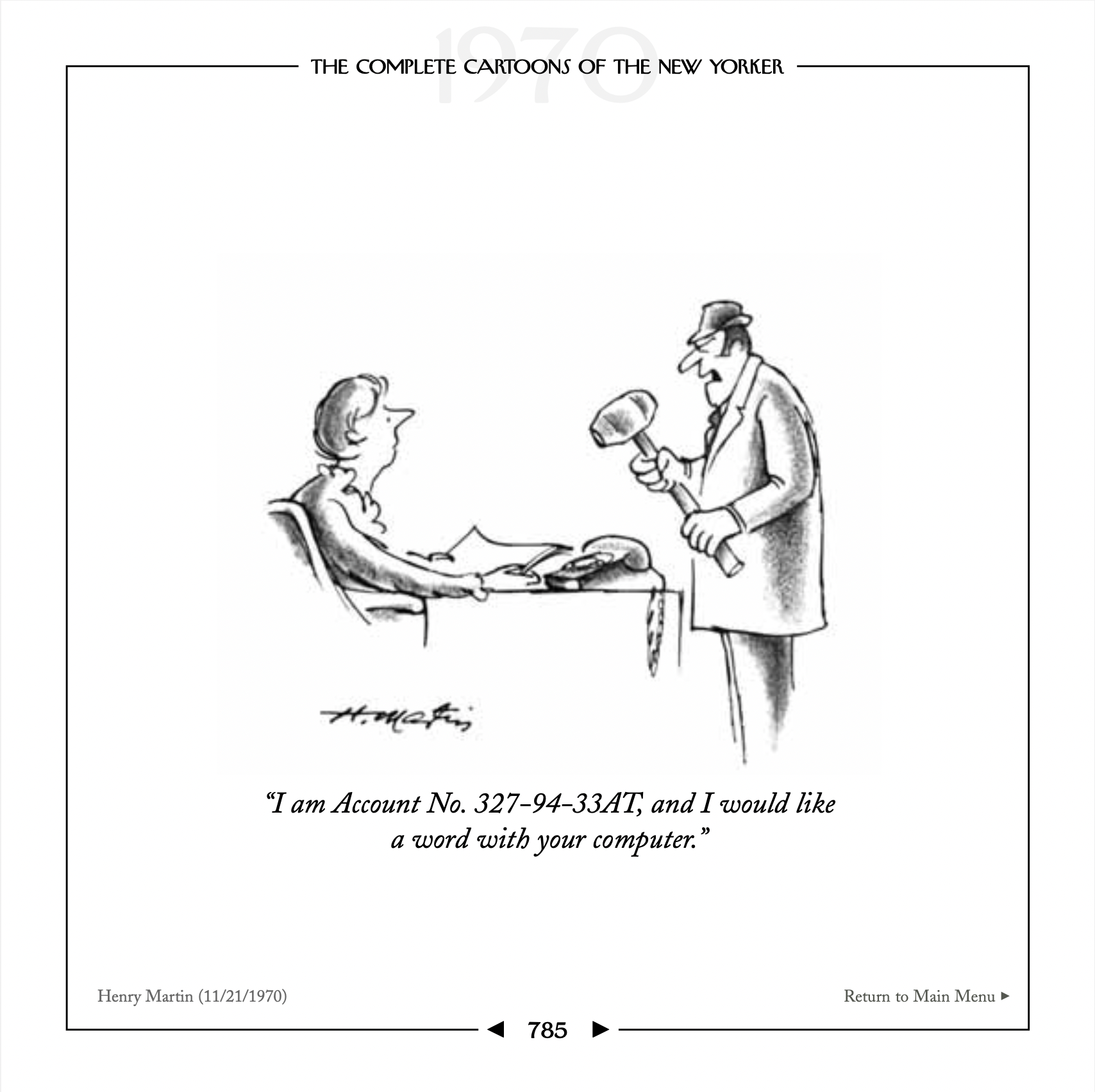
I am Account Number
Frustration with computers may be familiar to us now, but in the late 1960s and early 1970s it had already reached a new level.
The general public was aware that computers, or “mainframes,” were impacting their lives, but they had little recourse and no access to their own information within computerized systems. Which isn’t far removed from the present, actually, considering search engines, social media, and AI.
It’s interesting that the man wielding the sledgehammer doesn’t give his name – he’s simply a number in the eyes of the computer.1
-
Cartoon by Henry Martin, The New Yorker, November 11, 1970. Listed in The Complete Cartoons of The New Yorker, by Robert Mankoff and David Remnick, 2004. ↩︎
Shudder at "AI" in 1964
Many researchers shudder at the phrase “artificial intelligence.” Its anthropomorphic overtones, they say, often arouse irrelevant emotional responses – i.e., in people who think it sacrilegious to try to imitate the brain.1


-
Gilbert Burck, “Will the Computer Outwit Man?”, The Boundless Age of the Computer, Part VI, Fortune, Vol. LXX, No. 4, October 1964. Quote in footnote on page 120. Cartoon on page 121 by Nicholas Solovioff. ↩︎
Mop and pail
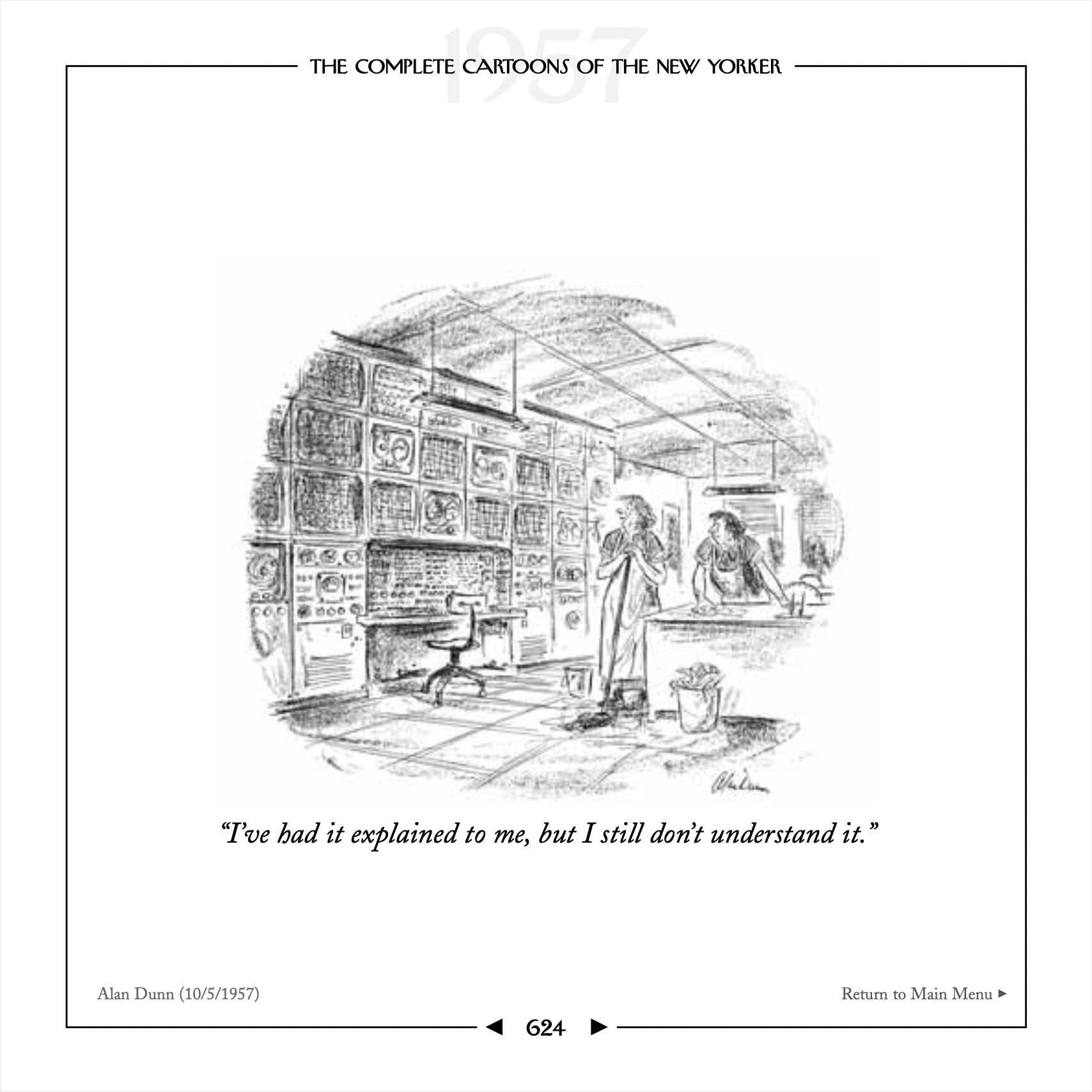
The “mop and pail” in the computer room were a constant theme for mainframes in the late 1950s and 1960s. In this cartoon the “it” is unclear, which is part of the humor. Is the “it” referencing computing in general, the fixation of people with computers, or an attempt to converse with the machine, or other possibilities?1
-
Cartoon by Alan Dunn, The New Yorker, October 5, 1957. Listed in The Complete Cartoons of The New Yorker, by Robert Mankoff and David Remnick, 2004. ↩︎
The computer programmer catcher
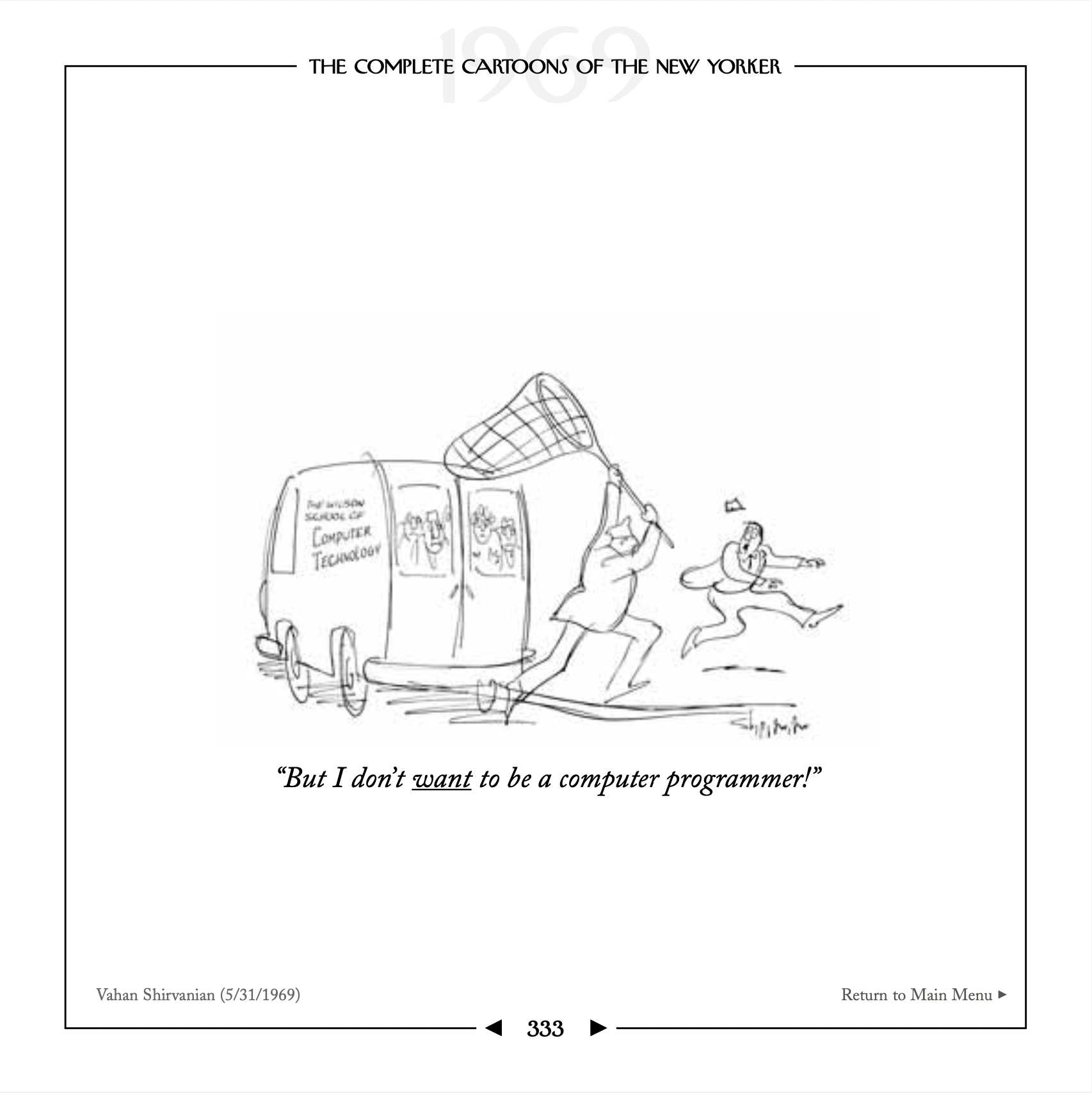
These days it’s more likely to be AI engineering than computer programming, but the rapid cultural change is similar.1
The cartoon is from the book (with accompanying CD image files), The Complete Cartoons of The New Yorker, by Robert Mankoff and David Remnick, 2004.
-
Cartoon by Vahan Shirvanian, The New Yorker, May 31, 1969. Listed in The Complete Cartoons of The New Yorker, by Robert Mankoff and David Remnick, 2004. ↩︎
AI slop
John Oliver on Last Week Tonight regarding AI slop.
“AI slop is basically the newest iteration of spam.” (3:26)
“It’s not just that we can get fooled by fake stuff, it’s that the very existence of it then empowers bad actors to dismiss real videos and images as fake. It’s an idea called the liar’s dividend.” (24:33)
“AI slop can be…worryingly corrosive to the general concept of objective reality.” (25:46)