
digital culture
Grace Hopper documentary - "The Queen of Code"
The Queen of Code at FiveThirtyEight (Wayback Machine link)
(YouTube video no longer available)
Also, an interview with the director of the short film at NPR, on All Tech Considered: Grace Hopper, ‘The Queen Of Code,’ Would Have Hated That Title
The moth, or first computer “bug” mentioned in the video and audio above.
There’s also a Grace Hopper GitHub sticker (shown below) called the “Gracehoptocat.” The sticker was given out at the Grace Hopper Celebration of Women in Computing (Wayback Machine link).

(Revised and republished April 1st, 2025)
Creating Digital Professionals
BBC gives children mini-computers in Make it Digital scheme, by Jane Wakefield at BBC News, 2015:
The initiative is part of a wider push to increase digital skills among young people and help to fill the digital skills gap. The UK is facing a significant skills shortage, with 1.4 million "digital professionals" estimated to be needed over the next five years.
Interesting controversy too:
The BBC Micro, launched in the 1980s, played a big role in making computing mainstream but it was not without controversy. The broadcaster's decision to link up with Acorn Computers angered Sir Clive Sinclair as he prepared to launch a rival machine, the ZX Spectrum.
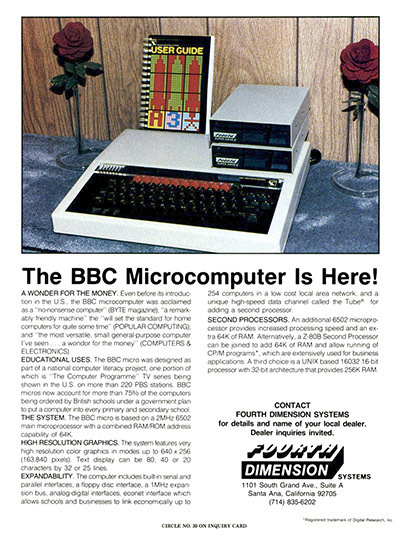
Below, a 1983 advertisement in Interface Age magazine, "The BBC Microcomputer is here!" (via Wikipedia)
(Revised and republished April 23rd, 2025)
Just a Little Acronym We Thought Up
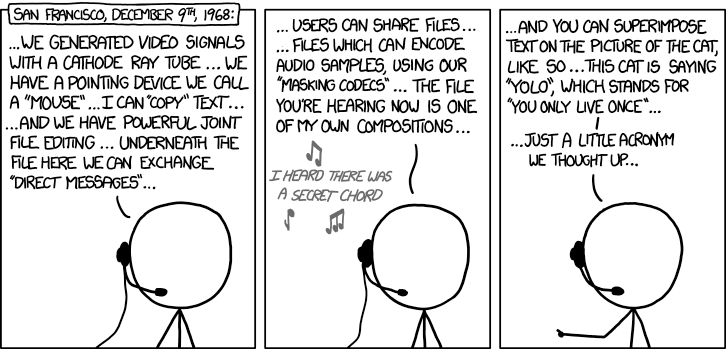
xkcd comic on Douglas Engelbart and the "Mother of All Demos" in 1968
The video below is the “Mother of All Demos” at the Internet Archive
1968 Demo - FJCC Conference Presentation Reel #1 by SRI International
(Revised and republished April 2nd, 2025)
It Looks Like 20 Feet
If only I had this when I was still riding ramps!
www.youtube.com/watch?v=MNL9kuWwFes (video no longer available)
NYTimes on Jim Parsons and Intel advertisements.
How Deep is Your Photography? by Intel (and Jim Parsons)
The three cameras shoot simultaneously, then combine the overlaid information to create an image file that has many more capabilities than a standard JPEG. Once an image is captured, it is processed into a high-quality, depth-mapped file.
“It creates a fat JPEG,” said Erhhung Yuan, system architect and lead developer for Intel RealSense snapshot. “It’s essentially a JPEG with more metadata fields, including the computed depth map.”
The ad is pretty cheesy, but the technology looks interesting. I can see smartphones having more cameras on the backside, and the “fat JPEGS” will require faster processors, more storage, and so on, pushing the limits of the devices even more.
(Revised and republished April 13th, 2025)
Mainframes are so 50 years ago
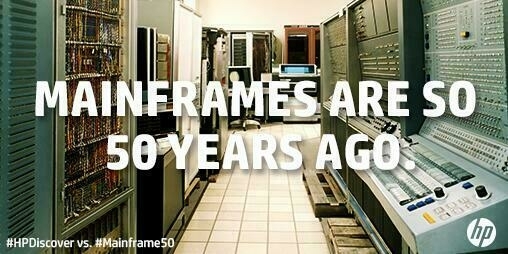
I came across this tweet as an advertisement in my own Twitter feed. It’s meant to be ironic, mainframes are still around, it’s more so the way they’re perceived that’s changed.
twitter.com/hpdiscover/status/453556126043615232 (Twitter links no longer available)
The comments are funny too:
@HPDiscover
this is SO not true. Shame on you HP.
#bigdata
— Camila Caldas (@camilaclbcaldas)
April 8, 2014
@HPDiscover
Another one who will eat his words about the death of the Mainframe. Here we go again !!! Have u even watched Matrix ? LOL!! — DD (@Cojinua77)
April 9, 2014
(Revised and republished April 2nd, 2025)
Computers Never Lie About Love
“Comput-Her Baby” - a short film by Dave Goldson and Neal Chastain, 1968
A satire on computer dating and matchmaking. The song “Strangers in the Night” plays while punched cards are sorted by mainframe computers.
The color in the Vimeo embed below (sadly, no longer available) is a bit off, toward a faded, pinkish hue. The video is available at UC Berkely and UC San Diego, but I’m not sure of the condition of those reels. It’s also listed at the UCLA Film and Television archive in faded condition.
(Revised and republished April 2nd, 2025)
The Machine That Changed the World - video series
Thanks to Andy Baio, all five parts of The Machine That Changed the World are available online: http://waxy.org/2008/06/the_machine_that_changed_the_world/
The Machine That Changed the World is the longest, most comprehensive documentary about the history of computing ever produced, but since its release in 1992, it's become virtually extinct. Out of print and never released online, the only remaining copies are VHS tapes floating around school libraries or in the homes of fans who dubbed the original shows when they aired.
All 5 episodes are (sort of) available on YouTube.
The YouTube videos are blocked now, “on copyright grounds,” but they still play after a moment.
(Revised and republished April 2nd, 2025)
I Desire to Become Data
Fragments on Machines, a film by Emma Charles
An interesting and very artistic take on the materiality of digital culture, and the physical structures that support modern communication, computation, and data storage. The ventilation covers and shafts in the beginning of the video seem so mundane, but just a few steps inside is an entire world of noise and movement.
My muscle has been replaced by flex and copper. My brain a server. Ones and zeros my voice. I exist as a phantom, an iridescent color. I speak in shimmering tones to the hidden construction of the form. I desire to become data.
(Revised and republished April 13th, 2025)
Archive Team - Robots.txt is a suicide note
ROBOTS.TXT is a stupid, silly idea in the modern era. Archive Team entirely ignores it and with precisely one exception, everyone else should too.
Archive Team interprets ROBOTS.TXT as damage and temporary madness, and works around it. Everyone should. If you don’t want people to have your data, don’t put it online.
(Revised and republished April 2nd, 2025)
The Holmdel Computer Center - Part 2
The Holmdel Computer Center, Part 2 – AT&T Archives (Wayback Machine link)
This rare look inside a Bell Labs computer center, specifically the one at the Holmdel location, which was referred to internally as the “HOCC” or the “HO CC”. This film was made as orientation for new employees who would need to use the computer center, and this, part 2 of 2 (see part 1), is about the programming center within the HOCC. One thing that’s notable about this film — different from Part 1 — is the preponderance of women working in the Programmer Services area. Around 1966, 7 years before this film was made, there were over 500 women working in “technical work” at Bell Labs, rather than administrative work, and many were in computing. A book and blog by Nathan Ensmenger examines the sociological history of computing, and why during the 1980s the computing field became more and more the province of men. Stories about women in the early decades of computing still reside in the world of the personal anecdote; it’s hard to assess the exact data on how many women worked in the field in the 1960s and 1970s.
The original video isn’t available on the Wayback Machine, but the YouTube version is embedded below.
(Revised and republished April 2nd, 2025)