
digital culture
The Holmdel Computer Center - AT&T archives
There’s some interesting artwork on the timeshare computer…reminds me of the “nose art” on military aircraft. In my archival research I’ve come across a few instances of pinup-style material, especially ASCII art printouts.
The video below is from 1973, slightly after the timeframe of my research, but certainly interesting.
The Holmdel Computer Center, Part 1 – AT&T Archives (Wayback Machine link)
The year was 1973, and the computer operating system UNIX, invented at Bell Labs by Ken Thompson and Dennis Ritchie, had just morphed into its third iteration or improvement, and had just been rewritten in the C programming language. This film, made as an orientation for the computer center at the Bell Labs Holmdel location, is a rare glimpse into the operations and procedures of an early 1970s research-oriented computing center. And as the 1973 Holmdel Computer Center only had IBM computers, it wasn't running a UNIX installation: the system was only ported to IBM computers in the years to come. In 1973, UNIX as a system was limited to installations on DEC computers, and there were UNIX installations at other locations of Bell Laboratories such as Indian Hill, Whippany, and, of course, Murray Hill (where UNIX and C were developed). Computers in the Bell System weren't just relegated to computer science or the development of computer language. They were employed for all kinds of complex engineering calculations, telecommunications applications, and, very occasionally, for making art and music.
The original video isn’t available on the Wayback Machine, but the YouTube version is embedded below.
(Revised and republished April 2nd, 2025)
Control Data Cyber 170 mainframes
Two Control Data Cyber 170 mainframe computers, side by side – one online, and one as a spare. (Photograph via Library of Congress)
SITE BUILDING 002 - SCANNER BUILDING - LOOKING AT DISC STORAGE SYSTEMS A AND B
The year on the photo is listed as 1999, which seems too recent given the feel of the picture. In the high-resolution TIFF, however, the date can be seen on the bulletin board, “21 Oct 99”. The Cyber 170 was produced in the late 1970s, so this unit is at least 20 years old.
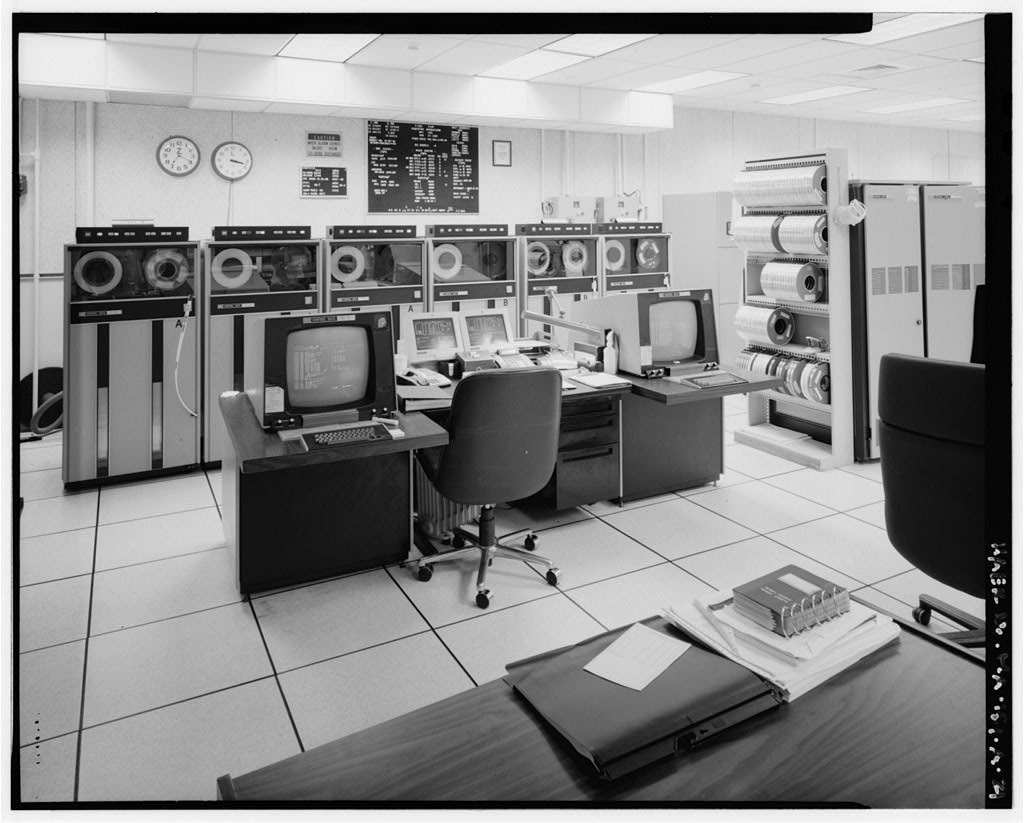
The photograph is part of this collection at LOC: Cape Cod Air Station, Technical Facility-Scanner Building & Power Plant, Massachusetts Military Reservation, Sandwich, Barnstable County, MA
(Revised and republished April 2nd, 2025)
Careers and Digital Lifespans
Campus digital workhorse running final laps after 35 years (Wayback Machine link), by Barbara Palmer, Stanford Report, 2003:
The remarkable thing is not that the mainframe will be retired -- the 35-year-old system is "like a jet slowly losing its engines," said Dick Guertin, a software developer who has worked at Stanford since 1970. What is amazing, say those whose work lives have spanned much of the computer revolution, is that the mainframe system and the ground-breaking applications designed here to run on it have held up so well for so long.
At its peak, there were 30,000 accounts, including noncampus users, on the mainframe. Some of what McWilliam is doing requires real detective work, since many of the people who opened the accounts have long ago left Stanford or retired.
Also – Forsythe Mainframe Retirement (Wayback Machine link):
The mainframe era officially ended on December 15, 2003 when the last of the mainframe accounts was closed down.
(Revised and republished April 2nd, 2025)
It was physically demanding labor
Hello, Goodbye - CDS Bids Farewell to Mainframe, Ushers in New Beginning
In 1998 the Catalog Distribution Service of the Library of Congress shutoff its mainframe computer and switched to a new system.
During the 1970s, the mainframes were used primarily to print catalog cards, which CDS once produced by the tens of millions. In those early days, as many as 30 staff members were required simply to service the units, performing such tasks as changing tape reels, threading tape and programming. "It was physically demanding labor," said Mr. Billingsley.
(Revised and republished April 2nd, 2025)
UCLA Differential Analyzer - 1948 film
UCLA’s 1948 Mechanical Computer Was Simply Gorgeous To Watch in Action (Wayback Machine link), by Matt Novak at Paleofuture, 2013.
I’ll need to get more information on the film clip’s provenance – it’s shown here through Gizmodo’s Vimeo channel without a source reference. It’s listed in the Paleofuture article as released by Popular Science via Paramount Pictures, 1948 (possibly through Shields Pictures Inc.).
More information at UCLA, Historical Research Highlights, “The Thinking Machine”
In December of 1977, the last working model of a mechanical differential analyzer in the world is donated by UCLA to the Smithsonian Institution for its pioneering computing display. The differential analyzer introduced much of Southern California industry to automatic computing, but became obsolete beginning in 1960 as it was replaced by computing machines with electronic circuits and vacuum tubes. From 1960 on, it was used mainly as a display piece, clanking away occasionally for student and public demonstrations.
Two more video clips of the UCLA differential analyzers at the Computer History Museum: http://www.computerhistory.org/revolution/analog-computers/3/143
(Revised and republished April 2nd, 2025)
Project poster and talk last October
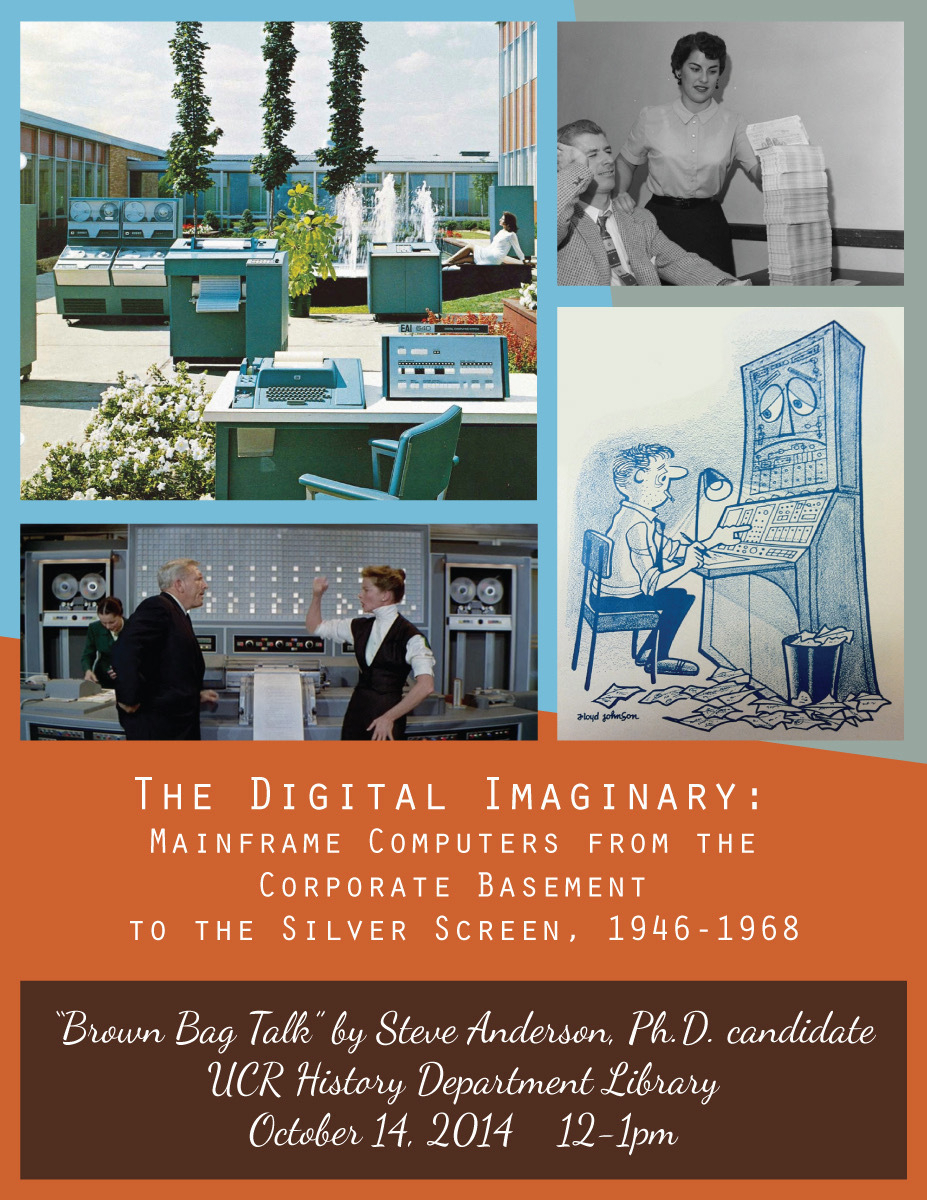
Last October I gave a “brown bag” talk (Wayback Machine link) over lunch in the History Department Library at the University of California, Riverside. I spoke for about 40 minutes and gave a wide overview of my project, using images and video clips to help illustrate my research. It was a great turnout of both professors and graduate students, and I received some terrific feedback that I was able to use for future talks.
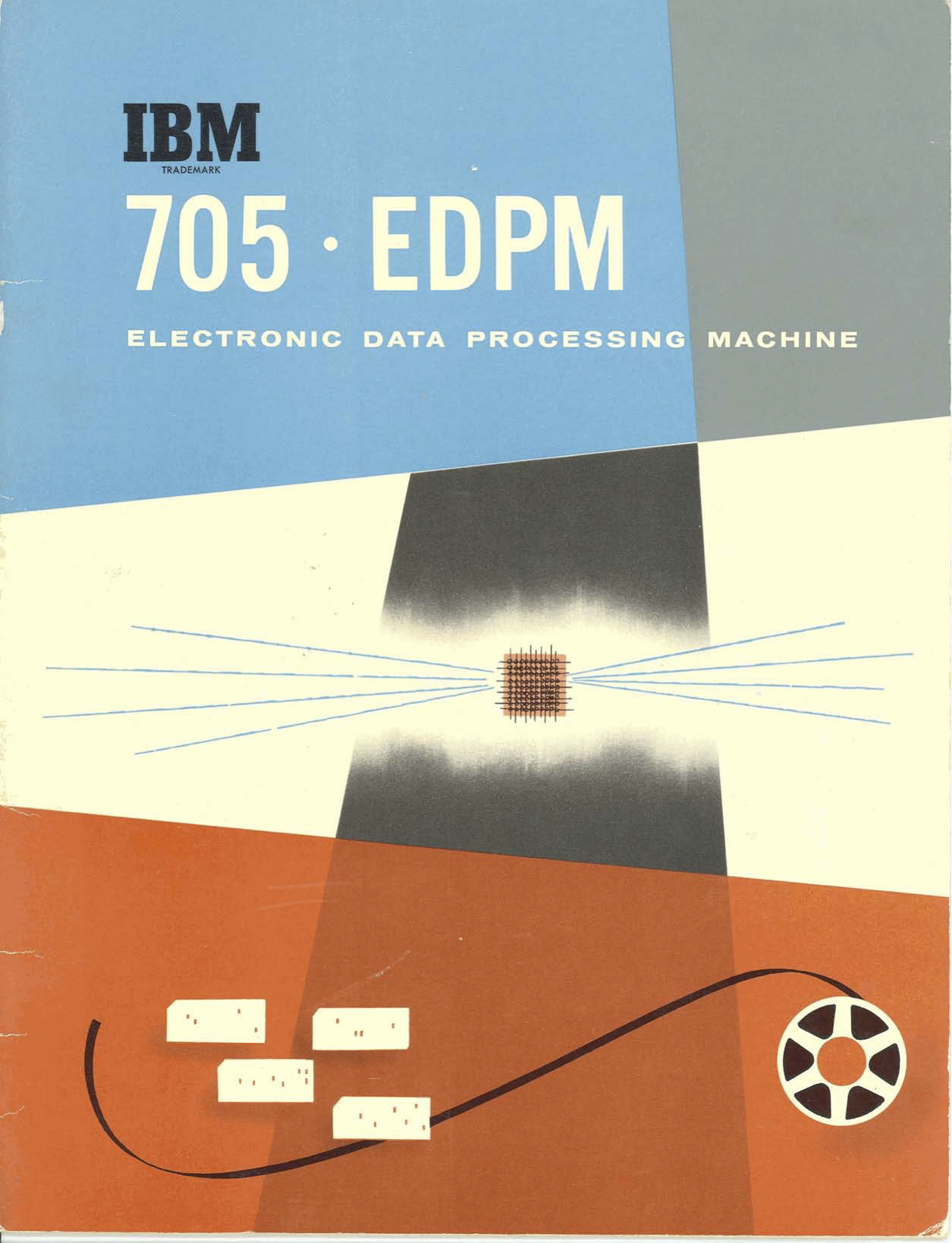
At the top is the poster I created for the talk at UCR, and the images come from a variety of primary source materials. The inspiration for the color scheme comes the brochure cover just above, which is featured in the online exhibit, “Selling the Computer Revolution,” at the Computer History Museum in Silicon Valley.
The brochure is for an IBM 705 EDPM (Electronic Data Processing Machine), a mainframe computer produced in the mid 1950s. Mainframes like the IBM 705 were powerful workhorses in the business world during the postwar era, handling payroll for thousands of employees. The brochure’s cover features a computer processing unit at the center, with punched cards and magnetic tape for data storage.
(Revised and republished April 6th, 2025)
Paperwork Explosion
This video, created by Jim Henson in 1967 for IBM, makes a great first post. So much anxiety, so little time, if only there was someone to help…like IBM!
Ben Kafka discusses this video in the Conclusion of his book, The Demon of Writing: Powers and Failures of Paperwork (2012), and also in this online West 86th article (Wayback Machine link):
The “paperwork explosion” expresses both a threat and a wish. The threat, of course, is that we are being overwhelmed by paperwork’s proliferation, its explosion — a threat that historian Ann Blair has recently traced through the early modern period. The wish is to convert all this cumbersome matter into liberating energy, which is exactly what explosions do. From Chaptal’s “electric fluid” to IBM’s “Machines Should Work, People Should Think” to USA.gov’s “Government Made Easy,” we remain attached to the idea that someday, somehow, we can liberate this energy, put it to other uses.
The “liberating energy” that Kafka speaks of also requires containment, it needs direction and control, services which IBM was ready to supply.
Two other aspects of paperwork which I’m researching are: (1) the degree to which IBM was instigating the “paperwork explosion” itself, where was it coming from, who else was worried about it, and (2) how the militaristic response to the demands of paperwork figure into the Cold War environment.
(Revised and republished April 6th, 2025)
Moth in Relay
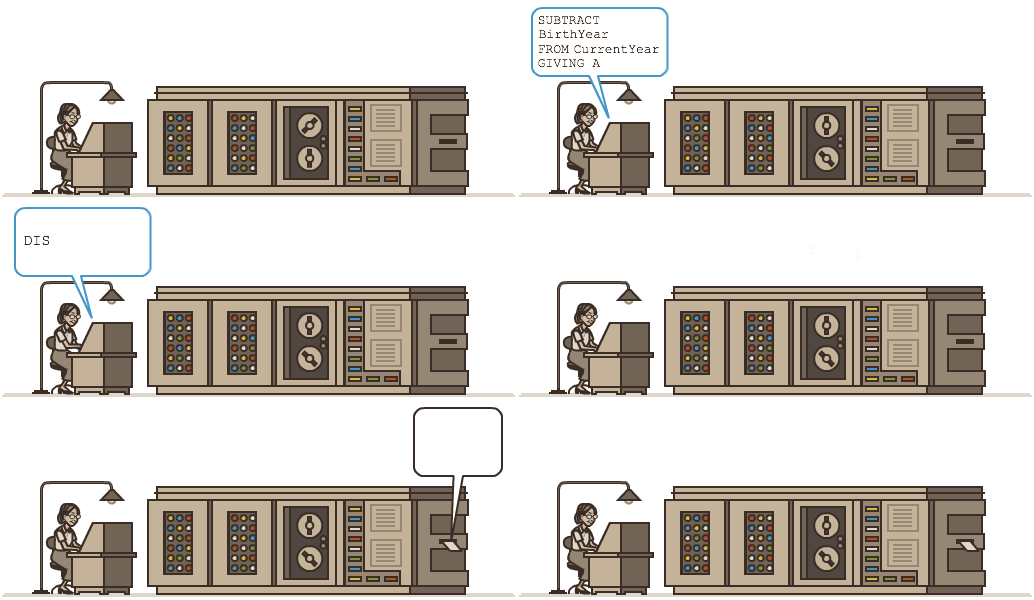
In 1947 a moth was found in a relay switch on the Mark II electromechanical computer, a true computer "bug." What's most interesting here isn't that an insect was found in the machine, but that the computer operator taped the moth into the logbook. It's almost as if the moth was trapped in a thin sheet of amber, preserved as the pre-digital ancestor of the tricksters within our own modern devices.
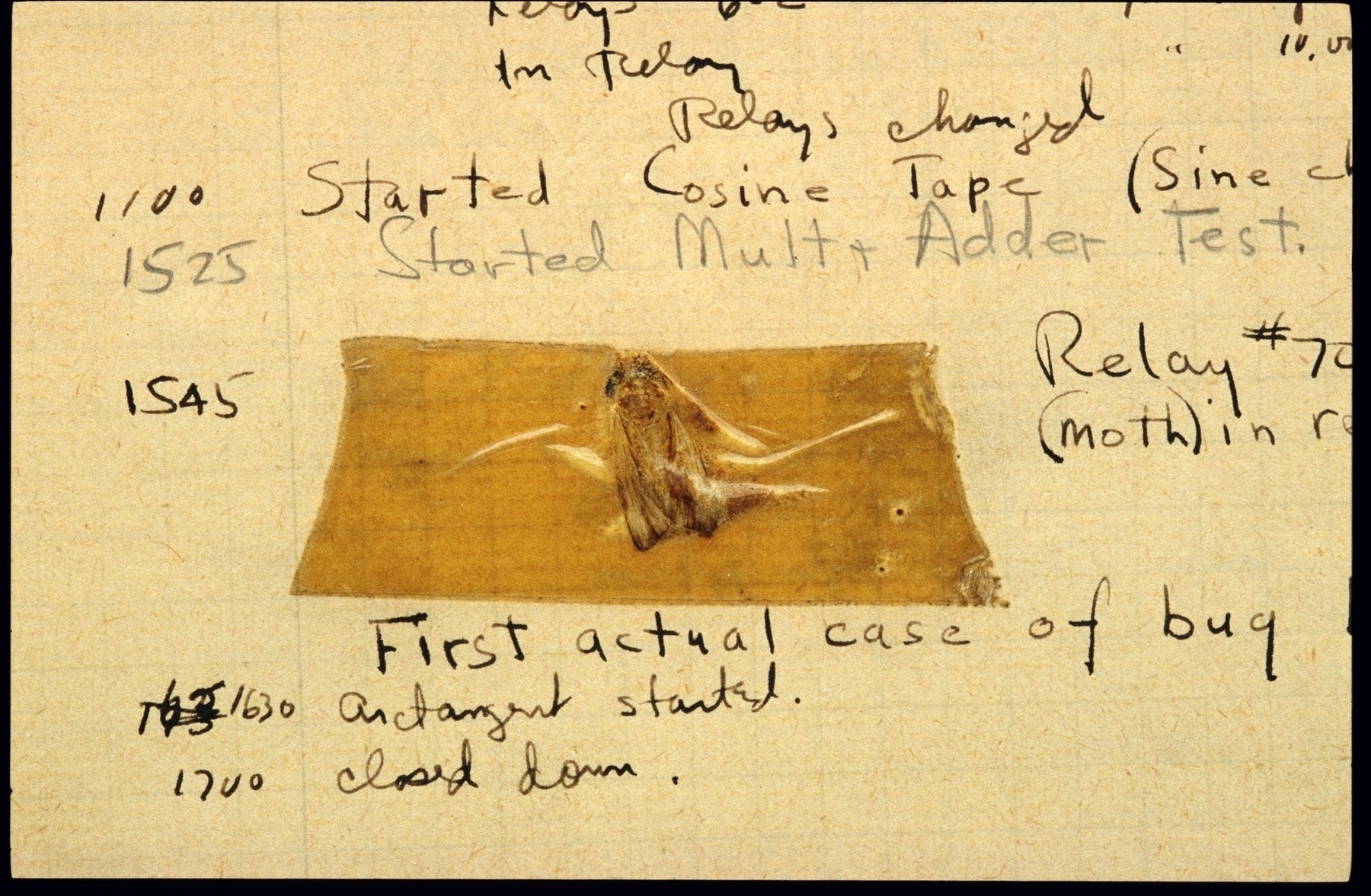
The insect was found by Grace Hopper (Wayback Machine link), a computer scientist and rear admiral in the US Navy. Google recently paid homage to Hopper with a "doodle" (below) showing her working on an early mainframe computer. Not only does the computer display an answer on a paper printout, but a moth also flies out at the end of the sequence.
(Revised and republished April 19th, 2025)
Assembled in the USA
Apple - Making the Mac Pro (2013)
I love videos like this, especially the “How it’s Made” series on the Discovery science channel.
The robotic ballet is mesmerizing, and it’s great that the new Mac Pro is assembled in the United States. With the complexity of the global marketplace, it seems unlikely that new high-tech devices could also be completely manufactured in the US though.
Google is producing the Motorola Moto X smartphone in the US too.
(Revised and republished April 19th, 2025)
Quantum Computing and Pizza Bagel Entanglement
Google, NASA, and D-Wave are teaming up to take quantum computing to the next level.
The case or container of the D-Wave is much more empty than I had suspected. It’s so different from portable computing which seeks to maximize internal dimensions for power usage and heat.
The biggest question is the question itself – “we don’t know what the best questions are to ask that computer, that’s exactly what we’re trying to understand now” (Eleanor Rieffel @ 4:52 in the video above).
(via kottke.org)
(Revised and republished April 19th, 2025 — I can’t help but think of Everything Everywhere All At Once)