digital humanities
Digital Matisse
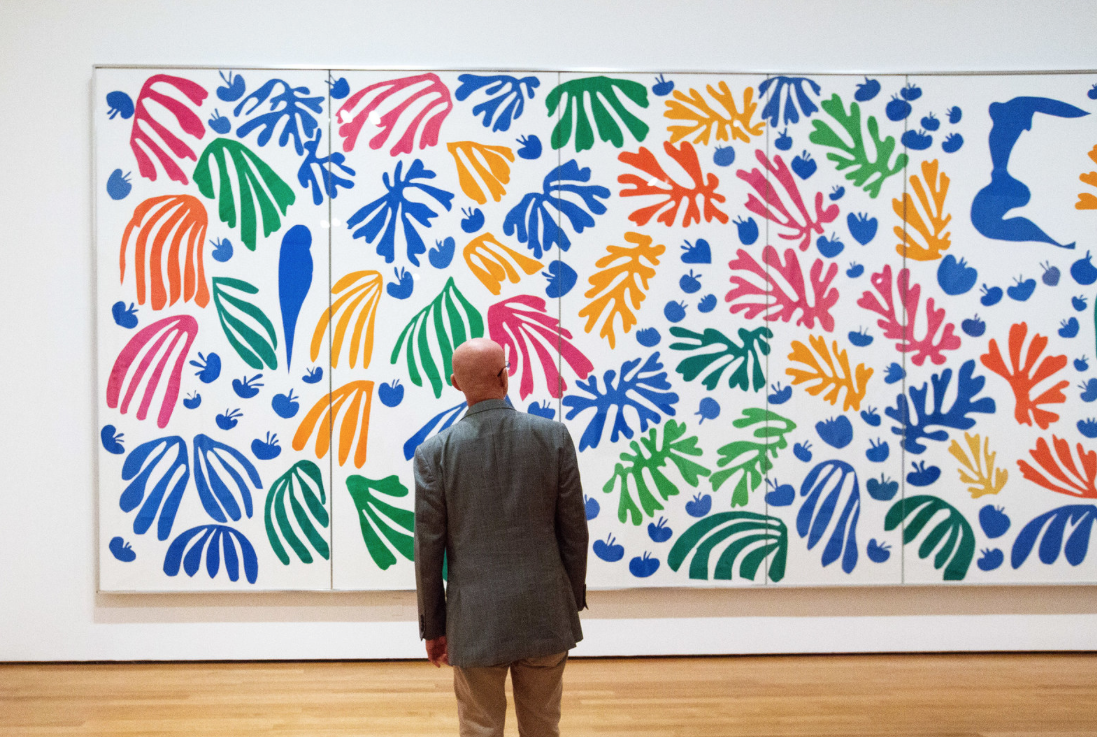
Speaking of museums and their digital presence, MoMA has an interactive exhibit covering their recent Matisse exhibition. I was lucky enough to be in New York for the AHA conference in early January, and I was able to see "Henri Matisse: The Cut-Outs" before it ended. Photography was not allowed inside the exhibit, though, so the images here are from the web. The New York Times also has an interactive Matisse "walk through." It functions as an active panoramic image, whereby you can scroll as though you were walking through the exhibit at MoMA.
Both of these interactive digital projects are wonderful, but of course nothing compares to viewing the artwork in person. I was surprised to see how large and expansive the cut-outs were, like The Parakeet and the Mermaid (over 11 feet high, and over 25 feet wide).
Paperwork Studies as an Historical Field
The Paper Trail Through History (NYTimes gift link), by Jennifer Schuessler, the New York Times, 2012:
Ms. Gitelman’s argument may seem like an odd lens on familiar history. But it’s representative of an emerging body of work that might be called “paperwork studies.” True, there are not yet any dedicated journals or conferences. But in history, anthropology, literature and media studies departments and beyond, a group of loosely connected scholars are taking a fresh look at office memos, government documents and corporate records, not just for what they say but also for how they circulate and the sometimes unpredictable things they do.
(Revised and republished April 3rd, 2025)
Project poster and talk last October
Last October I gave a “brown bag” talk (Wayback Machine link) over lunch in the History Department Library at the University of California, Riverside. I spoke for about 40 minutes and gave a wide overview of my project, using images and video clips to help illustrate my research. It was a great turnout of both professors and graduate students, and I received some terrific feedback that I was able to use for future talks.
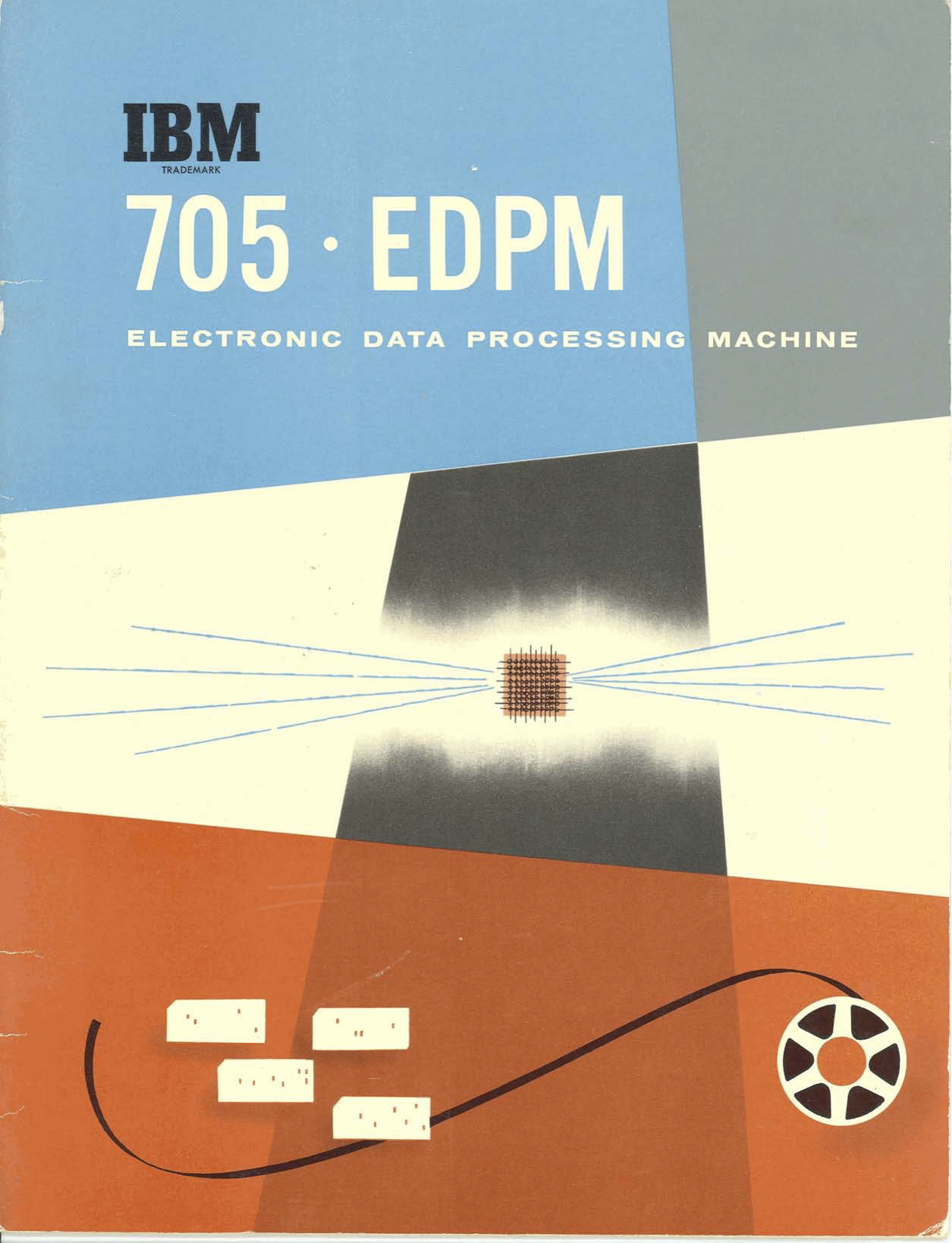
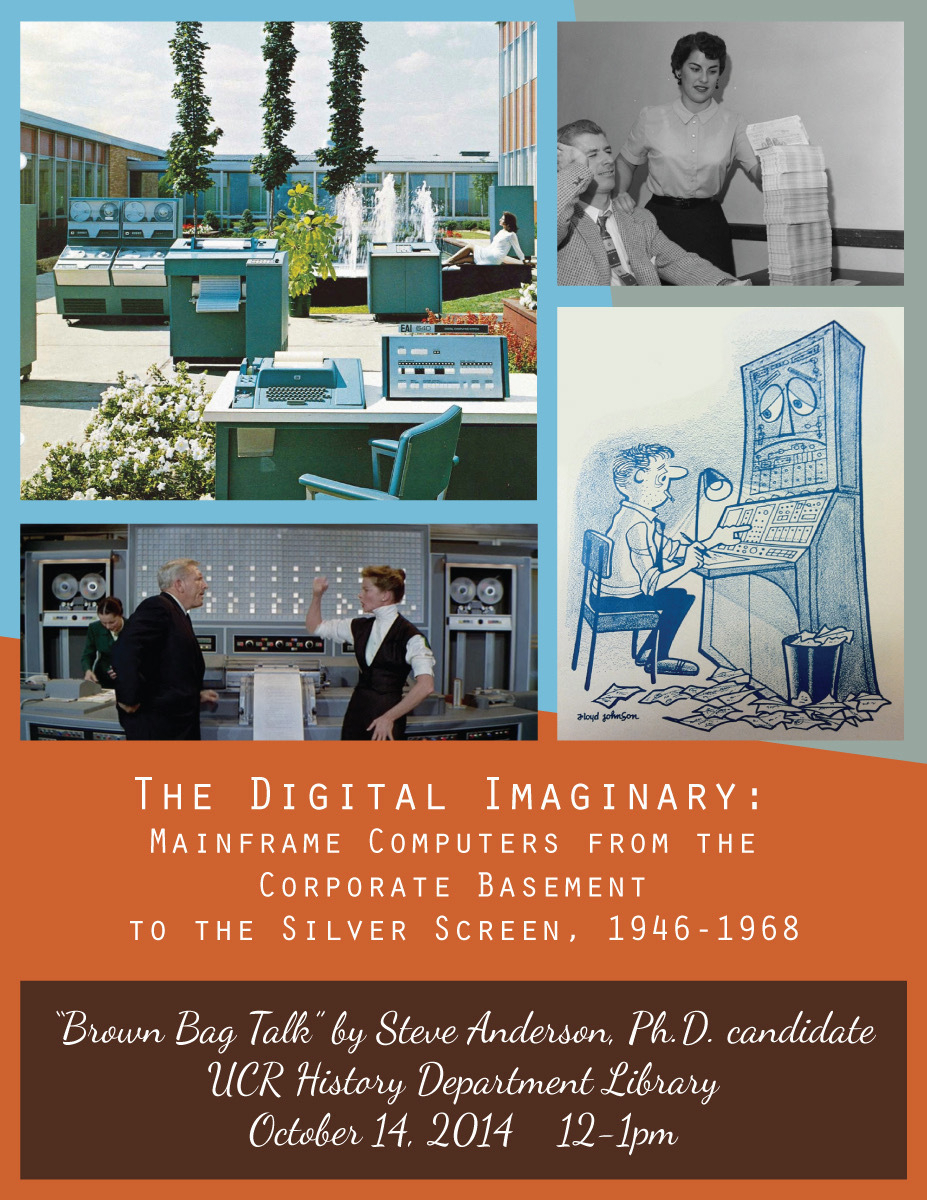
At the top is the poster I created for the talk at UCR, and the images come from a variety of primary source materials. The inspiration for the color scheme comes the brochure cover just above, which is featured in the online exhibit, “Selling the Computer Revolution,” at the Computer History Museum in Silicon Valley.
The brochure is for an IBM 705 EDPM (Electronic Data Processing Machine), a mainframe computer produced in the mid 1950s. Mainframes like the IBM 705 were powerful workhorses in the business world during the postwar era, handling payroll for thousands of employees. The brochure’s cover features a computer processing unit at the center, with punched cards and magnetic tape for data storage.
(Revised and republished April 6th, 2025)
My post on Wikipedia Edit-a-thons at NCPH Public History Commons
A few months ago, I wrote about a Wikipedia Edit-a-thon workshop at the UCR Library on the CDH (Critical Digital Humanities) and HGSA (History Graduate Student Association) websites. From these posts I was approached by Amy Tyson of the National Council on Public History's History@Work blog (Wayback Machine link). Amy covers the "In the Academy" section and she asked if I'd write about my experience at the workshop, which I happily agreed to. As it turned out, I also attended a THATCamp with a Wikipedia component, and I included that in my article as well. My post, "Editing in public: Online identity and the Wikipedia Edit-a-thon," is now live on the Public History Commons website.
The Impact of Wikipedia - Adrianne Wadewitz, 2012:
(Revised and republished April 19th, 2025)
Cultural Studies Association - Critical DH Roundtable call for participants
Critical Digital Humanities is putting together a roundtable for this year’s Cultural Studies Association. The conference will be held from May 21-24, 2015 in Riverside, California at the Riverside Convention Center. This year’s theme is Another University Is Possible: Praxis, Activism, and the Promise of Critical Pedagogy. In keeping with this year’s theme, we would like to explore the question “What does critical digital humanities look like?” The goal of this roundtable is to open a dialogue about critical approaches to digital humanities. Each participant will give a brief 5-7 minute provocation followed by a discussion.
Some topics for consideration, but not limitation:
- critical approaches to digital pedagogy, big data projects, data visualization, and digital scholarship
- specific campus initiatives, classes or programs that fall under the category of “critical digital humanities”
- limitations of critical digital humanities
- theory vs. practice in DH
- cultural studies and DH
- public scholarship, public humanities, and public history
Building off of the terrific energy from THATCamp, we would like to invite the DHSoCal community to consider having a role in this conversation! If you are interested, please contact http://cdh.ucr.edu/ and let us know what you are interested in discussing by Dec 1, 2014.
(Revised and republished April 23rd, 2025)
All Things Digital at UCR
At a few recent meetings we’ve talked about the new digital projects and resources being developed at UC Riverside, as well as other opportunities for graduate students and faculty interested in digital humanities.
Digital Scholars Lab
The UCR Rivera Library will be opening a new Digital Scholars Lab in the coming months. Over the Summer and Fall quarters, I’ve been working for the library as an advisor on digital scholarship projects and digital humanities in general. Once the Lab is open it will be a meeting place for graduate students, researchers, and faculty to start new digital scholarship projects or get help with existing ones. Although the Lab isn’t officially open at the moment, the Library is still happy to work with scholars and has many resources available. I’ve also made a website as a place to keep my notes for the development of the Lab. The website is a work in progress and it is not the official Lab website, but it does list many resources on digital scholarship and digital humanities: scholarslab.net
THATCamp DHSoCal
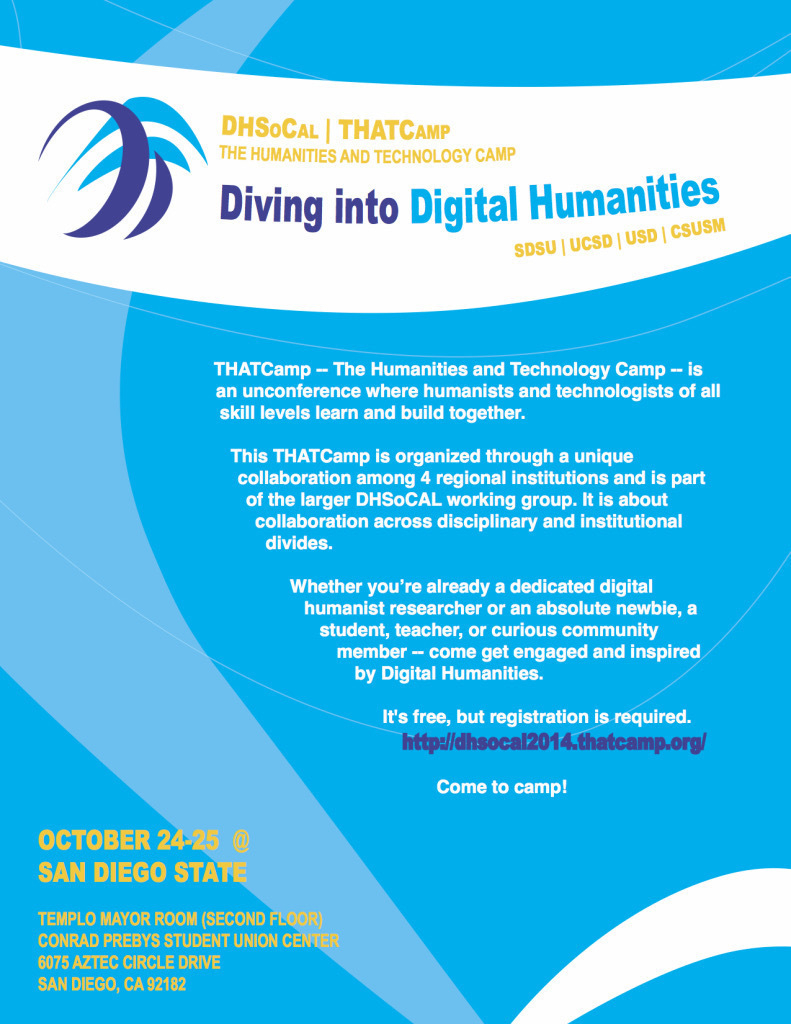
THATCamp DHSoCal: Diving into Digital Humanities
October 24th and 25th, 2014
San Diego State University
THATCamp is “The Humanities and Technology Camp,” and it is an “un-conference” meeting where humanists and technologists of all skill levels learn and build together in sessions proposed on the spot.
THATCamp DHSoCal: Diving into Digital Humanities will be held at San Diego State University, but it is organized through a unique digital humanities-style collaboration between 4 regional institutions: San Diego State University (SDSU), University of California at San Diego (UCSD), California State University at San Marcos (CSUSM), and University of San Diego (USD).
Visit http://dhsocal2014.thatcamp.org/ for more information and to register online. It is free and open to the public.
The spirit is inclusive, so, please send this email far and wide—to anyone (colleagues, students, friends) interested in learning about the digital humanities, getting involved in regional collaborations, and geeking out on the intersection between traditional humanities and digital technologies.
Join us to dive into the digital humanities!
More information on the DHSoCal digital humanities group can be found at: http://dhsocal.blogspot.com
(Revised and republished April 19th, 2025)
Digital Pedagogy workshop for TAs
Ever wondered what digital pedagogy is? Want to know what it’s like to teach online?
Wonder no more.
On February 19th, 2014, join us for an introductory session on digital pedagogy.
We will introduce you to the LMS (Learning Management System) Canvas, and we'll show you some of the applications that make online teaching as good (and sometimes better) than face–2-face teaching. We’ll also discuss some of the best practices for online education in the physical classroom and in the virtual one.
Location: UC Riverside, Surge 170
Date and time: Wednesday February 19th, 2014. 4–6PM
This is the first of hopefully many sessions aimed at training graduate students (and anyone else) in digital pedagogies.
(Revised and republished April 19th, 2025)
Notes on TEI and Markup Fundamentals workshop
My post at Critical Digital Humanities on a recent workshop: TEI and Markup Fundamentals http://cdh.ucr.edu/2014/02/16/notes-on-tei-and-markup-fundamentals-workshop/
On February 13th I attended a workshop on TEI and Markup Fundamentals sponsored by the Graduate Quantitative Methods Program. The workshop was given by Rochelle Gold and Kimberly Hall from the Department of English at UC Riverside.
TEI (Text Encoding Initiative) is a method of encoding texts with markup language for digital representation. TEI markup focuses on rendering the semantic qualities of texts more visible. For example, sentences and clauses can be marked within a text, as well as the lines and features of a poem. This granular level of encoding allows for digital representations of these texts to carry details and information beyond their normal forms, which is valuable for critical interpretation.
→ read more at the original post
(Revised and republished April 19th, 2025)
Event Archive: Rethinking Debates on Digital Learning . 12 Feb 2014
My post at Critical Digital Humanities on a recent talk:
CDH Event Archive: Rethinking Debates on Digital Learning
Yesterday CDH sponsored a talk by Professor Juliette Levy of the Department of History at UC Riverside. In her discussion, Professor Levy described her own evolution toward using digital technology in order to broaden the learning experience for her students.
Professor Levy’s talk began with a common experience many in academia have shared — traditional methods of teaching are not being adapted to the changing needs of students in our modern world.
The RSA talk by Sir Ken Robinson, which was turned into an animated video, was central to describing this need for change. There is a great chasm between the needs of students and the pace of innovation within the classroom.
→ read more at the original post
(Revised and republished April 19th, 2025)