digital humanities
BAM Colloquium this Friday
Please join us for the Year-End Colloquium for Graduate Students in "BAM." Designated Emphasis in Book, Archive, and Manuscript Studies – http://bam.ucr.edu (Wayback Machine link)
Friday, June 7, 2013. 10:00am to Noon
English Department Conference Room (HMNSS 2212)
Presentations by Steve Anderson, Cori Knight, and Heather Van Mouwerik
Display of printshop projects by Rebecca Addicks, Ann Garascia, Cori Knight, Jessica Roberson, and Anne Sullivan
This will also be a celebration of the new Mellon Workshop Grant awarded to the Material Cultures of the Book Working Group – http://bookhistory.ucr.edu (Wayback Machine link)
(Revised and republished April 23rd, 2025)
CDH event: Animated Music Screening and Talk - May 30th
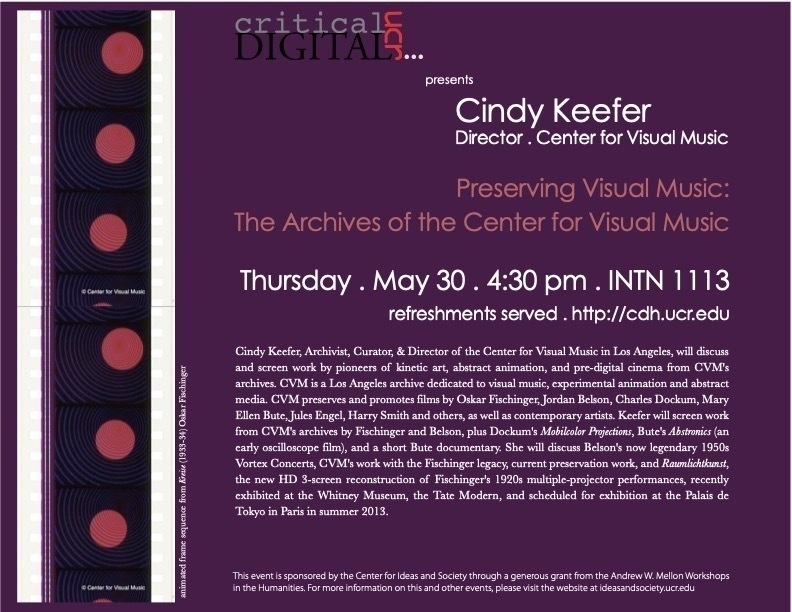
Cindy Keefer, Archivist, Curator & Director . Center for Visual Music
Preserving Visual Music : The Archives of the Center for Visual Music
THURSDAY . May 30, 2013 . 4:30 PM . INTN 1113 . Refreshments served .
Cindy Keefer, Director of the Center for Visual Music Los Angeles, will discuss and screen work by pioneers of kinetic art, abstract animation and pre-digital cinema from CVM's archives. CVM is a Los Angeles archive dedicated to visual music, experimental animation and abstract media. CVM preserves and promotes films by Oskar Fischinger, Jordan Belson, Charles Dockum, Mary Ellen Bute, Jules Engel, Harry Smith and others, as well as contemporary artists. Keefer will screen work from CVM's archives by Fischinger and Belson, plus Dockum's Mobilcolor Projections, Bute's Abstronics (an early oscilloscope film), a short Bute documentary, and more. She will also discuss Belson's now legendary 1950s Vortex Concerts, CVM's work with the Fischinger legacy, current preservation work, and Raumlichtkunst, the new HD 3-screen reconstruction of Fischinger's 1920s multiple-projector performances, recently exhibited at the Whitney Museum, the Tate Modern, and scheduled for exhibition at the Palais de Tokyo in Paris in summer 2013.
This is the last event Critical Digital Humanities will host for the 2012-2013 season. Please join us for this exciting presentation. [cdh.ucr.edu](http://cdh.ucr.edu)
(Revised and republished April 23rd, 2025)
Geographies of Detention at UCR Arts Block
UCR ARTSblock presents the exhibition: Geographies of Detention: From Guantánamo to the Golden Gulag
June 1 – September 7, 2013*
California Museum of Photography, UCR ARTSblock
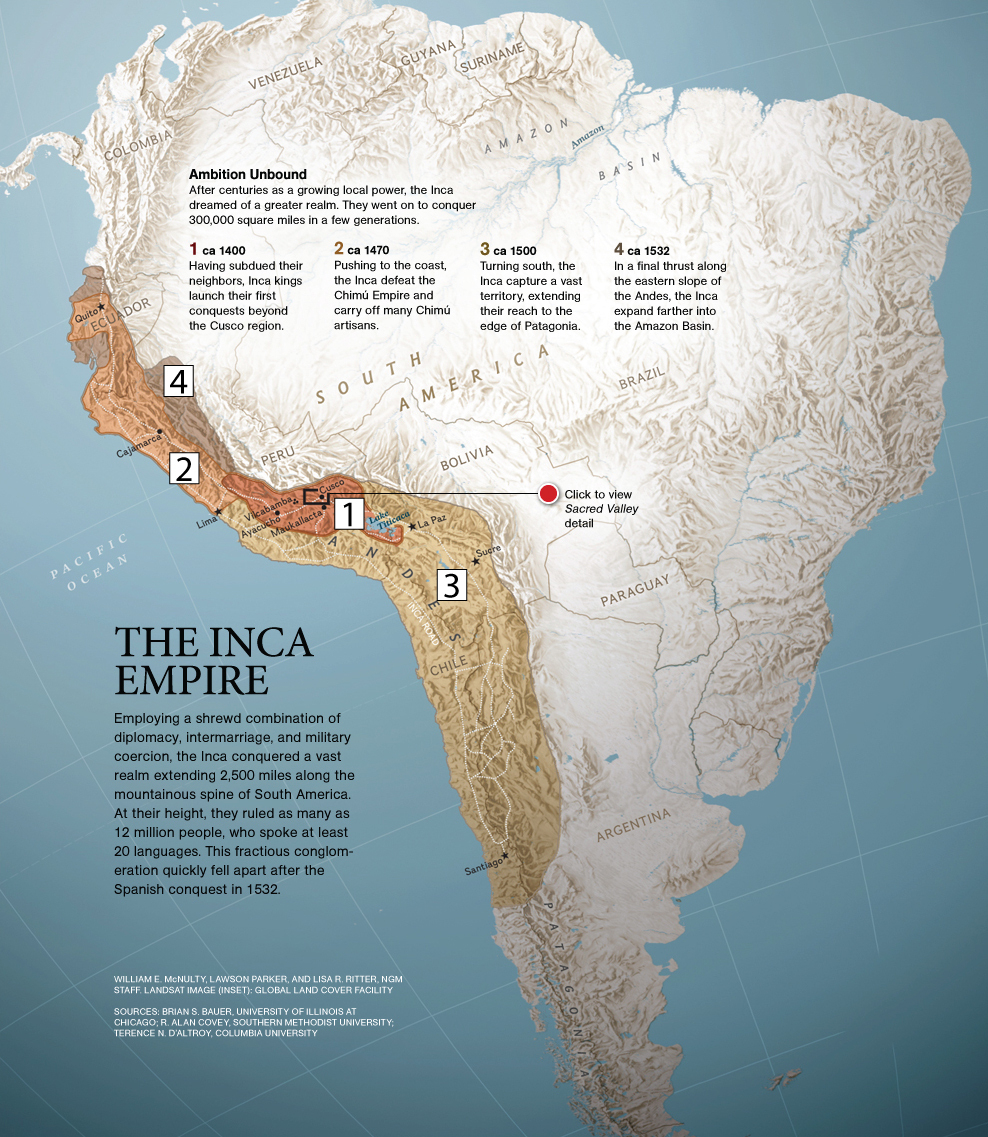
Map of the Inca Empire
This map of the Inca Empire (Wayback Machine link) is great for showing the rapid expansion of the Incas across the Andes region. On the original map it was a little difficult to correlate the numbered excerpts with the colored regions, so I made new numbers that will show up a little better on classroom projectors.
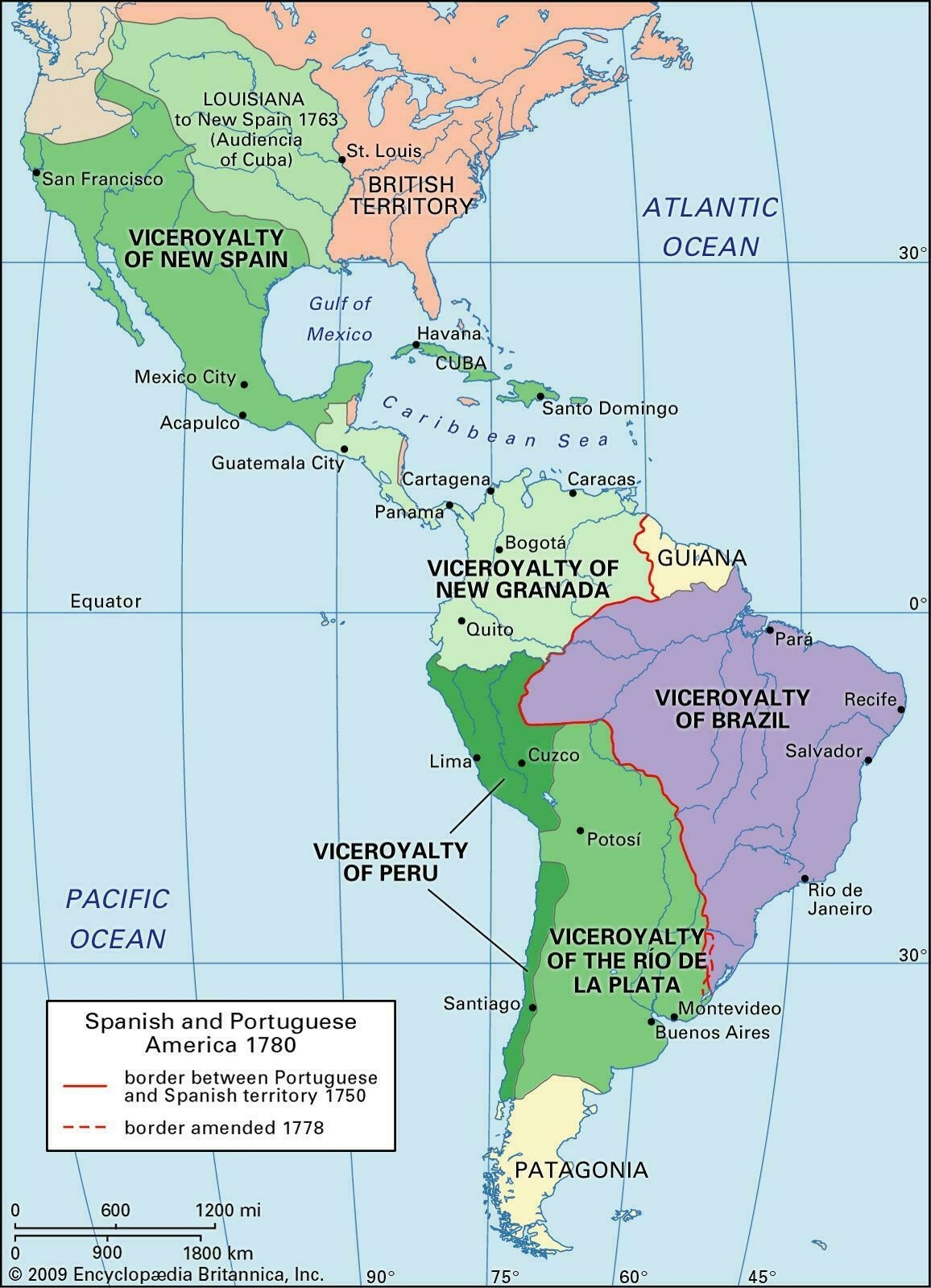
Map of Spanish Viceroyalties
I came across this map of Spanish viceroyalties (link no longer available) a few months ago, and since it can be difficult to find good maps online I thought I'd post it here. Even though there's a plethora of maps on the Internet, it still seems like the best ones are either overhead-projector transparencies, or printed in books. This map is of Spanish territory in the Americas during the eighteenth century – it covers all of Latin America and the Spanish-American colonial empire, as well as neighboring British territory, and the Portuguese viceroyalty of Brazil.
The Spanish viceroyalties shown on the map are:
- Viceroyalty of New Spain
- Viceroyalty of New Granada
- Viceroyalty of Peru
- Viceroyalty of the Río de la Plata
(Revised and republished April 21st, 2025)
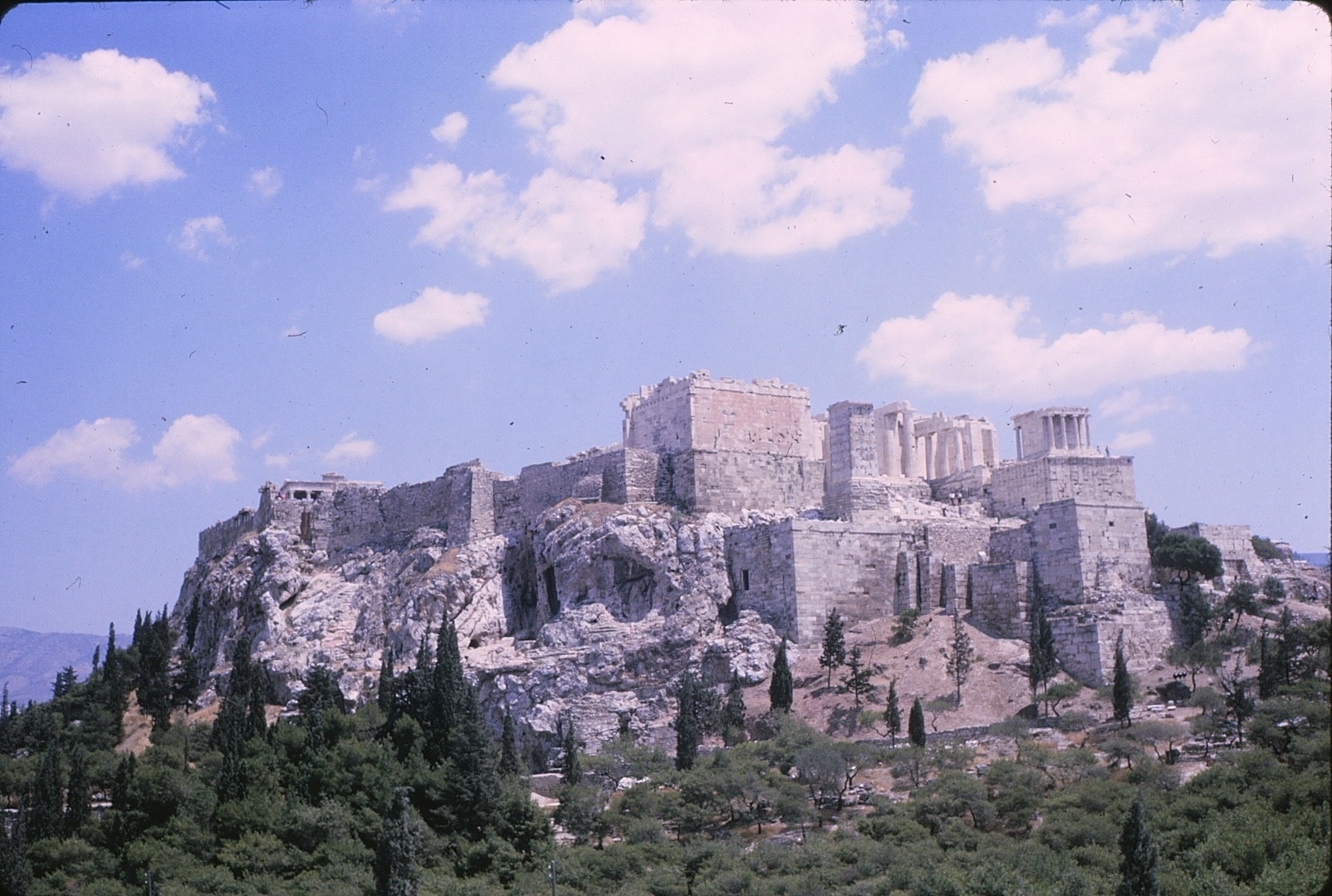
Ruins of the Acropolis, 1966 - Athens, Greece
These photos (Kodak slides) were also taken by my grandparents while on vacation in 1966, and they've been scanned but not altered. The first image is of the Acropolis of Athens, and in this citadel all the other images except the last are found.
The middle images are of the Parthenon, and also of the Odeon of Herodes Atticus, an ancient amphitheater.
Second to last is the Porch of the Caryatids, also known as the "Porch of the Maidens,"which is found at the Erechtheion, an ancient Greek temple in the Acropolis.
The last image is of the Panathenaic Stadium, the location of the Panathenaic Games between the sixth and third centuries BC. The Panathenaic Games were like the Ancient Olympic Games but only Athenians competed. In the late 1800s the stadium was rebuilt, and the first modern Olympic Games took place there in 1896.
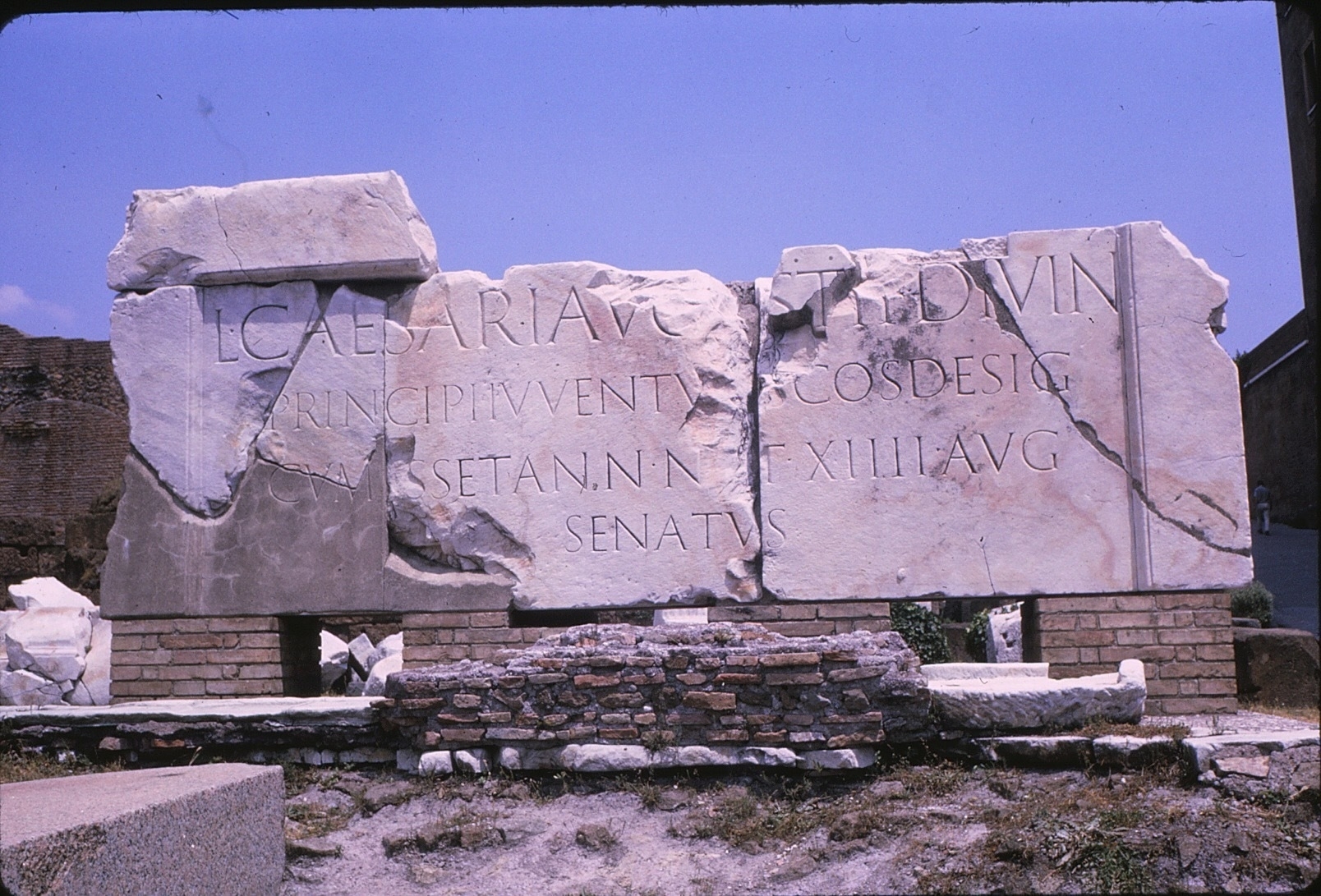
Roman Ruins, 1966 - Rome, Italy
These photos of Roman ruins were taken in 1966 by my grandparents. These images are scanned Kodak slides, and they have not been altered. The first image with the inscription is near the Basilica Aemilia of the Forum. More information can be found on the inscription at the Index of Latin Inscriptions at the University of Chicago (97A23.11).
I’m assuming the last image is also in the Forum, and the other slides are some interesting takes of the Colosseum.
Presenting in Seattle
I just returned from a history conference in Seattle. It was the annual meeting of the Pacific Coast Branch of the American Historical Association (Wayback Machine link). It was a great conference, well run, and very friendly.
I presented, "Processing the Suburbs: Gender, Technology, and Paperwork in Postwar America." At the heart of the paper is the need to provide a historical component to the Digital Humanities, and to better understand the historical foundations of modern digital culture.
(Revised and republished April 21st, 2025)
New Digital Humanities Minor at UCLA
I'm interested to find out more about this new program at UCLA. It seems like an excellent way to get students propelled into Digital Humanities projects. Students Should Embrace UCLA's New Digital Humanities Minor: Daily Bruin
(Revised and republished April 21st, 2025)
Born Digital newspaper project
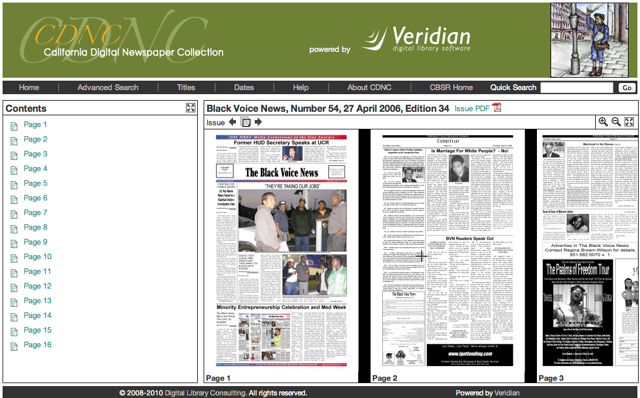
This summer I've been working on the "Born Digital" project at the Center for Bibliographic Studies and Research (CBSR) at UC Riverside. The Born Digital project is an effort to help preserve small, weekly newspapers that are currently being produced in digital formats.
While digital technology has allowed modern newspapers to be created and distributed in new and exciting ways, it has also made the records of those newspapers more fragile. The Born Digital project helps newspaper publishers preserve, and make accessible to the general public at no charge, their digital files. As an online archive, the Born Digital project is a portion of the California Digital Newspaper Collection, which holds titles from 1846 to the present.
More information about the Born Digital project is available in this UCR news article: http://newsroom.ucr.edu/2667 (Wayback Machine link)
(Revised and republished April 21st, 2025)