digital humanities
Quantum Computing 101
Quantum Computers Animated, Piled Higher and Deeper (PHD Comics)
The illustrations for this video on quantum computing are fantastic, especially the "0/1" transition at 1:40.
(via Hacker News)
(Revised and republished April 19th, 2025)
Rewiring Class Emails and Student Interaction with Piazza
In a previous post I wrote about the experience of teaching an online class as a TA. One of the primary tools we used for the course was Piazza, and it was instrumental in shifting the burden of email to a more open and constructive arena.
Infectious Information: History and the Dissertation Quarantine
On July 22nd, 2013, the American Historical Association published to their blog a statement regarding the embargo of dissertations (Wayback Machine link). The suggestion was for digital embargo periods to be lengthened from around 1-3 years to 6 years, so that new PhD graduates could revise their dissertation manuscript for the purpose of creating a book for publication. As a significant revision of the dissertation, this book would then become a major component within the process of applying for tenure.
The back-end of online classes
In "Who is Driving the Online Locomotive," (Wayback Machine link) Rob Jenkins asks some pertinent questions about the force and direction of online education. There is definitely the feeling that something is coming, and those who aren't prepared will be lost by the wayside...or flattened by the train. However, this feeling of online education as the next-big-thing has been palpable for a couple of decades now. The latest gust of wind in the sails has been the infamous MOOC, but it's really more about the intersection of budget cuts and the ubiquity of social networking. It's also very unfortunate that there is usually little discussion of the differences between types of online classes – a MOOC with thousands of participants is a very different thing from a small online-class of 40 students.
BAM Colloquium this Friday
Please join us for the Year-End Colloquium for Graduate Students in "BAM." Designated Emphasis in Book, Archive, and Manuscript Studies – http://bam.ucr.edu (Wayback Machine link)
Friday, June 7, 2013. 10:00am to Noon
English Department Conference Room (HMNSS 2212)
Presentations by Steve Anderson, Cori Knight, and Heather Van Mouwerik
Display of printshop projects by Rebecca Addicks, Ann Garascia, Cori Knight, Jessica Roberson, and Anne Sullivan
This will also be a celebration of the new Mellon Workshop Grant awarded to the Material Cultures of the Book Working Group – http://bookhistory.ucr.edu (Wayback Machine link)
(Revised and republished April 23rd, 2025)
CDH event: Animated Music Screening and Talk - May 30th
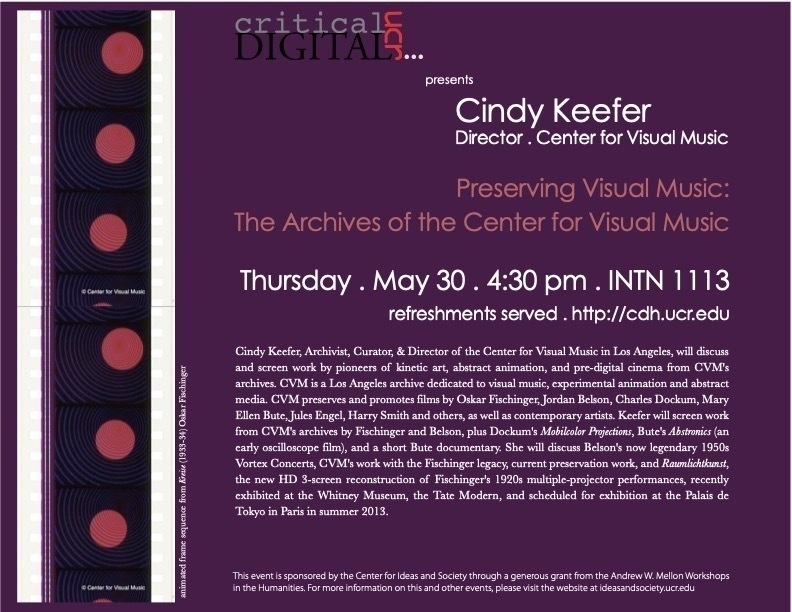
Cindy Keefer, Archivist, Curator & Director . Center for Visual Music
Preserving Visual Music : The Archives of the Center for Visual Music
THURSDAY . May 30, 2013 . 4:30 PM . INTN 1113 . Refreshments served .
Cindy Keefer, Director of the Center for Visual Music Los Angeles, will discuss and screen work by pioneers of kinetic art, abstract animation and pre-digital cinema from CVM's archives. CVM is a Los Angeles archive dedicated to visual music, experimental animation and abstract media. CVM preserves and promotes films by Oskar Fischinger, Jordan Belson, Charles Dockum, Mary Ellen Bute, Jules Engel, Harry Smith and others, as well as contemporary artists. Keefer will screen work from CVM's archives by Fischinger and Belson, plus Dockum's Mobilcolor Projections, Bute's Abstronics (an early oscilloscope film), a short Bute documentary, and more. She will also discuss Belson's now legendary 1950s Vortex Concerts, CVM's work with the Fischinger legacy, current preservation work, and Raumlichtkunst, the new HD 3-screen reconstruction of Fischinger's 1920s multiple-projector performances, recently exhibited at the Whitney Museum, the Tate Modern, and scheduled for exhibition at the Palais de Tokyo in Paris in summer 2013.
This is the last event Critical Digital Humanities will host for the 2012-2013 season. Please join us for this exciting presentation. [cdh.ucr.edu](http://cdh.ucr.edu)
(Revised and republished April 23rd, 2025)
Geographies of Detention at UCR Arts Block
UCR ARTSblock presents the exhibition: Geographies of Detention: From Guantánamo to the Golden Gulag
June 1 – September 7, 2013*
California Museum of Photography, UCR ARTSblock
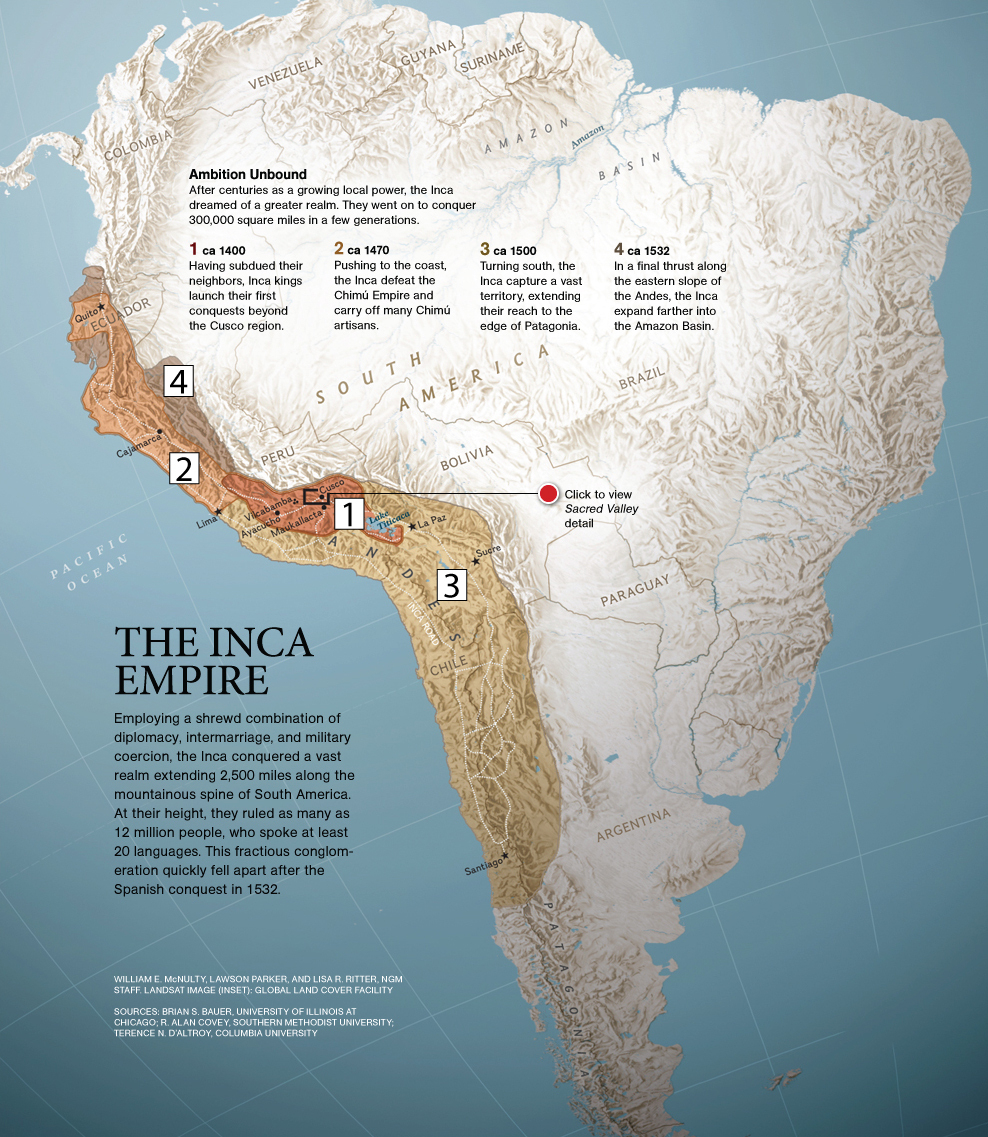
Map of the Inca Empire
This map of the Inca Empire (Wayback Machine link) is great for showing the rapid expansion of the Incas across the Andes region. On the original map it was a little difficult to correlate the numbered excerpts with the colored regions, so I made new numbers that will show up a little better on classroom projectors.
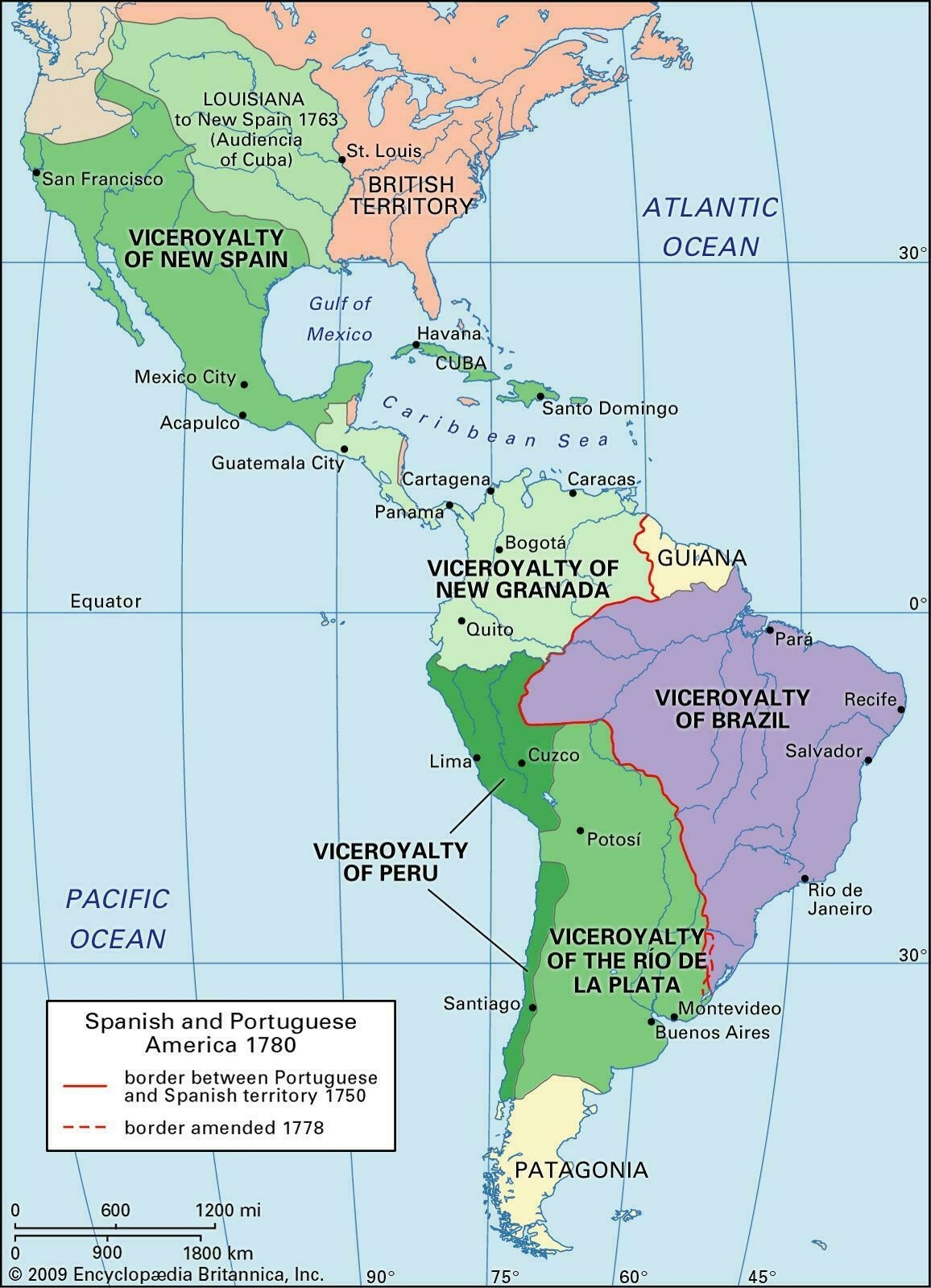
Map of Spanish Viceroyalties
I came across this map of Spanish viceroyalties (link no longer available) a few months ago, and since it can be difficult to find good maps online I thought I'd post it here. Even though there's a plethora of maps on the Internet, it still seems like the best ones are either overhead-projector transparencies, or printed in books. This map is of Spanish territory in the Americas during the eighteenth century – it covers all of Latin America and the Spanish-American colonial empire, as well as neighboring British territory, and the Portuguese viceroyalty of Brazil.
The Spanish viceroyalties shown on the map are:
- Viceroyalty of New Spain
- Viceroyalty of New Granada
- Viceroyalty of Peru
- Viceroyalty of the Río de la Plata
(Revised and republished April 21st, 2025)
Ruins of the Acropolis, 1966 - Athens, Greece
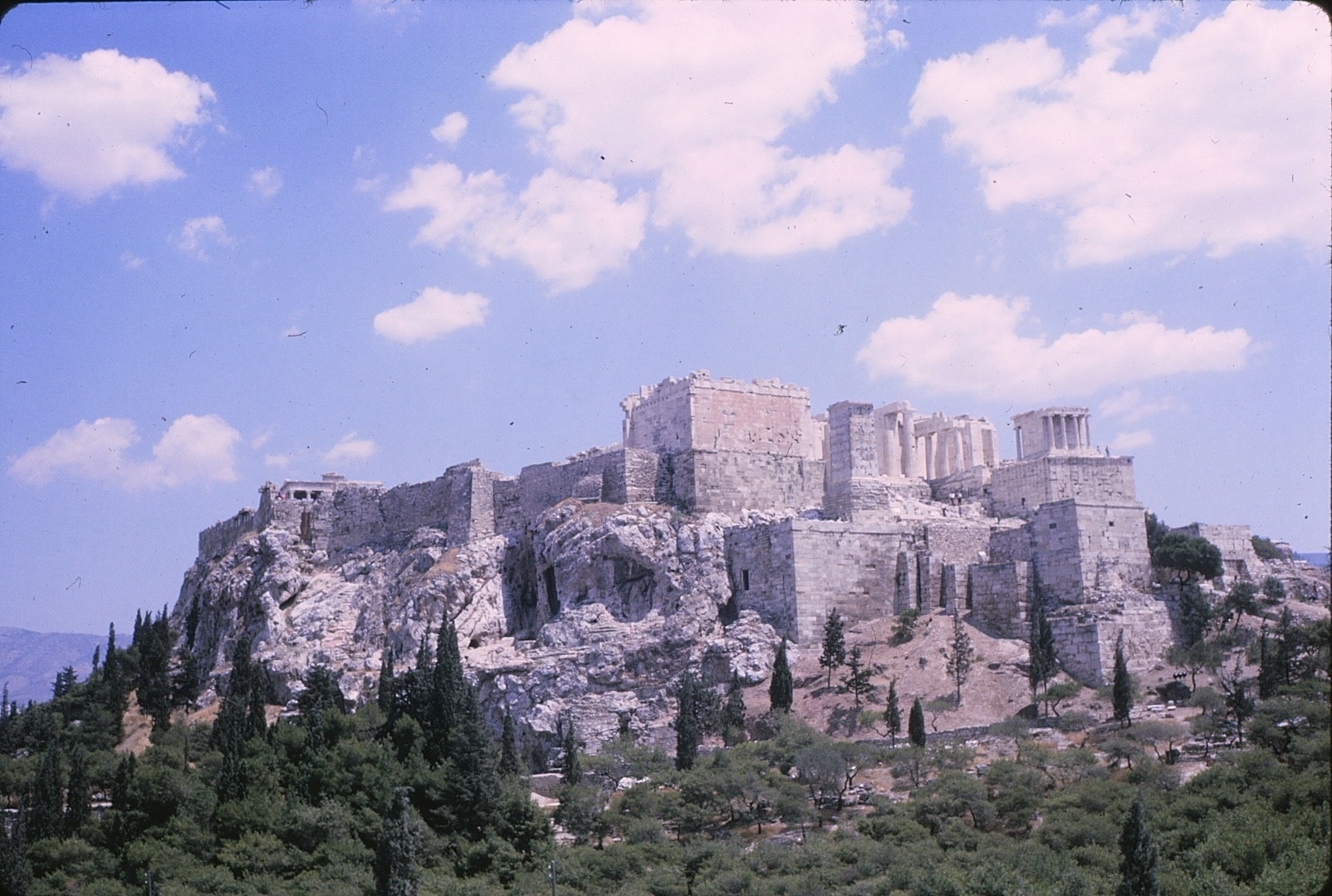
These photos (Kodak slides) were also taken by my grandparents while on vacation in 1966, and they've been scanned but not altered. The first image is of the Acropolis of Athens, and in this citadel all the other images except the last are found.
The middle images are of the Parthenon, and also of the Odeon of Herodes Atticus, an ancient amphitheater.
Second to last is the Porch of the Caryatids, also known as the "Porch of the Maidens,"which is found at the Erechtheion, an ancient Greek temple in the Acropolis.
The last image is of the Panathenaic Stadium, the location of the Panathenaic Games between the sixth and third centuries BC. The Panathenaic Games were like the Ancient Olympic Games but only Athenians competed. In the late 1800s the stadium was rebuilt, and the first modern Olympic Games took place there in 1896.