
history
Project poster and talk last October
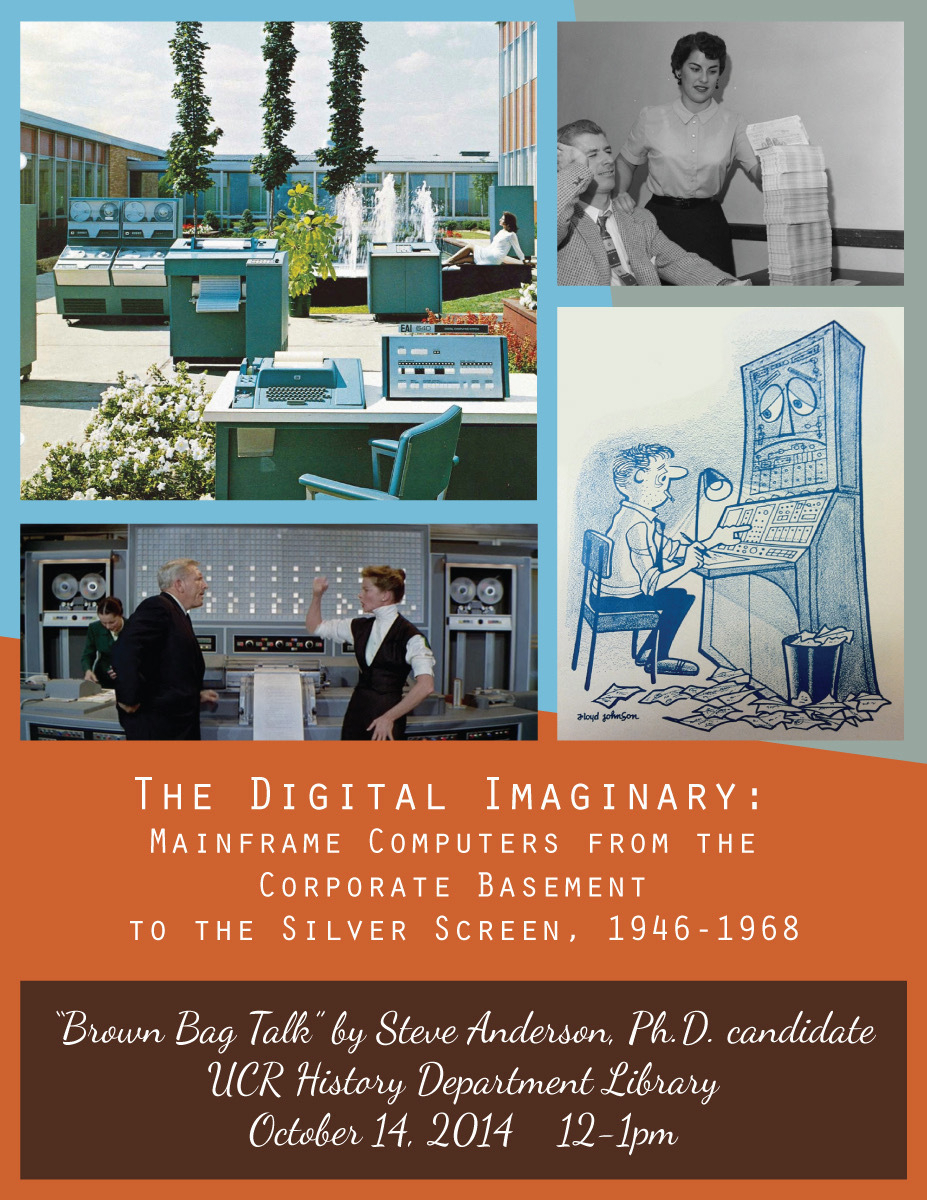
Last October I gave a “brown bag” talk (Wayback Machine link) over lunch in the History Department Library at the University of California, Riverside. I spoke for about 40 minutes and gave a wide overview of my project, using images and video clips to help illustrate my research. It was a great turnout of both professors and graduate students, and I received some terrific feedback that I was able to use for future talks.
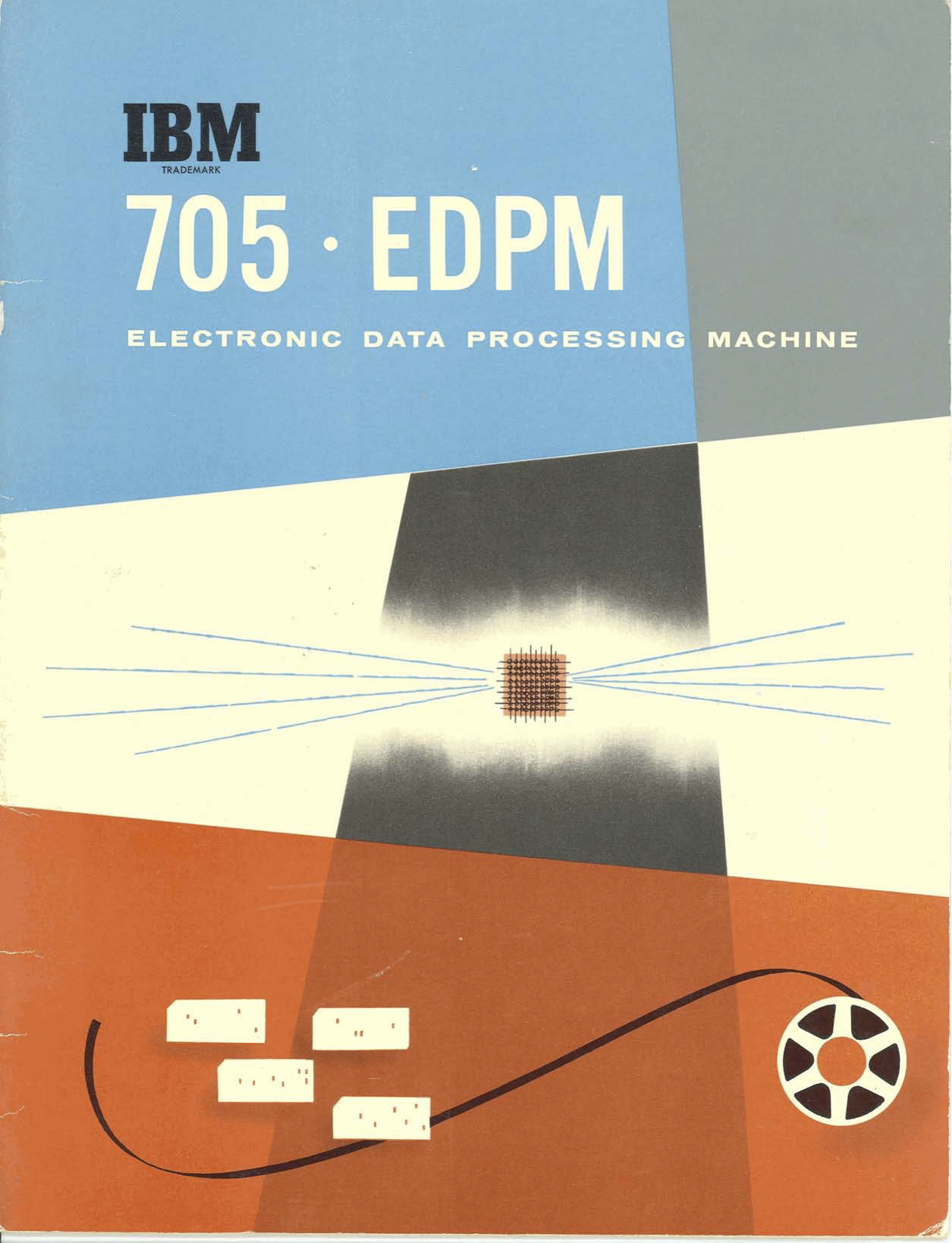
At the top is the poster I created for the talk at UCR, and the images come from a variety of primary source materials. The inspiration for the color scheme comes the brochure cover just above, which is featured in the online exhibit, “Selling the Computer Revolution,” at the Computer History Museum in Silicon Valley.
The brochure is for an IBM 705 EDPM (Electronic Data Processing Machine), a mainframe computer produced in the mid 1950s. Mainframes like the IBM 705 were powerful workhorses in the business world during the postwar era, handling payroll for thousands of employees. The brochure’s cover features a computer processing unit at the center, with punched cards and magnetic tape for data storage.
(Revised and republished April 6th, 2025)
Paperwork Explosion
This video, created by Jim Henson in 1967 for IBM, makes a great first post. So much anxiety, so little time, if only there was someone to help…like IBM!
Ben Kafka discusses this video in the Conclusion of his book, The Demon of Writing: Powers and Failures of Paperwork (2012), and also in this online West 86th article (Wayback Machine link):
The “paperwork explosion” expresses both a threat and a wish. The threat, of course, is that we are being overwhelmed by paperwork’s proliferation, its explosion — a threat that historian Ann Blair has recently traced through the early modern period. The wish is to convert all this cumbersome matter into liberating energy, which is exactly what explosions do. From Chaptal’s “electric fluid” to IBM’s “Machines Should Work, People Should Think” to USA.gov’s “Government Made Easy,” we remain attached to the idea that someday, somehow, we can liberate this energy, put it to other uses.
The “liberating energy” that Kafka speaks of also requires containment, it needs direction and control, services which IBM was ready to supply.
Two other aspects of paperwork which I’m researching are: (1) the degree to which IBM was instigating the “paperwork explosion” itself, where was it coming from, who else was worried about it, and (2) how the militaristic response to the demands of paperwork figure into the Cold War environment.
(Revised and republished April 6th, 2025)
Moth in Relay
In 1947 a moth was found in a relay switch on the Mark II electromechanical computer, a true computer "bug." What's most interesting here isn't that an insect was found in the machine, but that the computer operator taped the moth into the logbook. It's almost as if the moth was trapped in a thin sheet of amber, preserved as the pre-digital ancestor of the tricksters within our own modern devices.
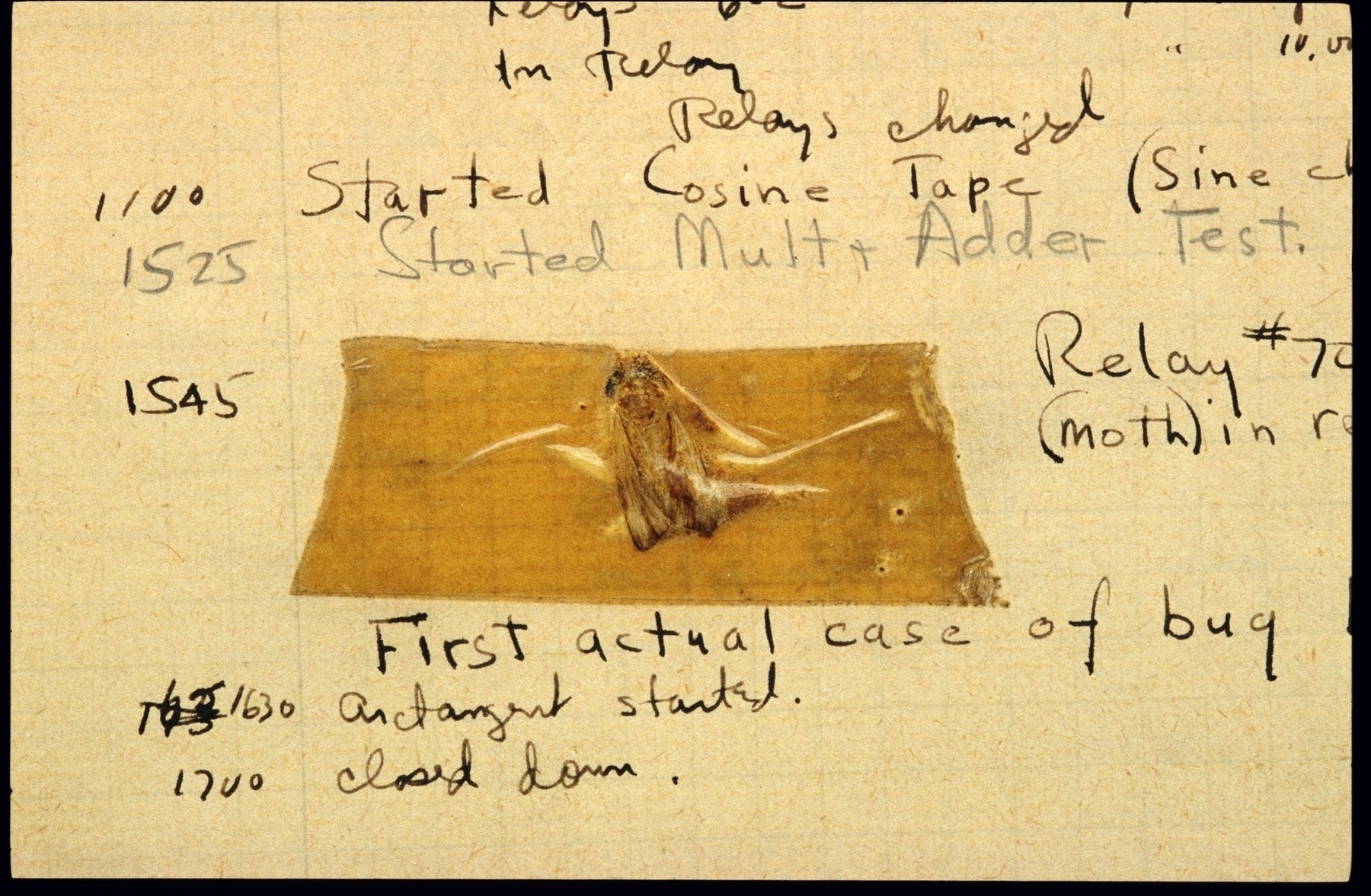
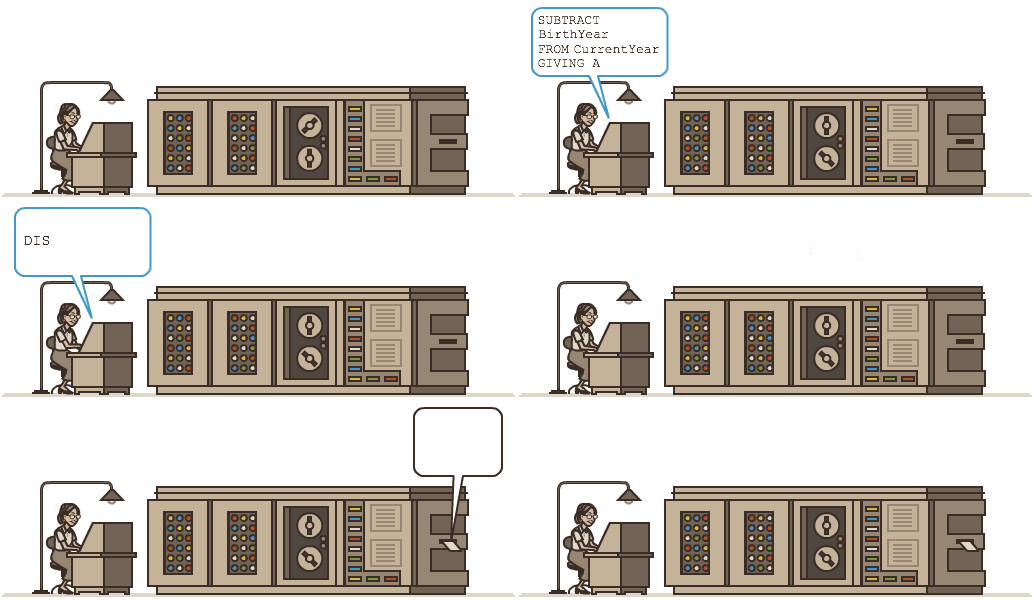
The insect was found by Grace Hopper (Wayback Machine link), a computer scientist and rear admiral in the US Navy. Google recently paid homage to Hopper with a "doodle" (below) showing her working on an early mainframe computer. Not only does the computer display an answer on a paper printout, but a moth also flies out at the end of the sequence.
(Revised and republished April 19th, 2025)
Lincoln's shadow
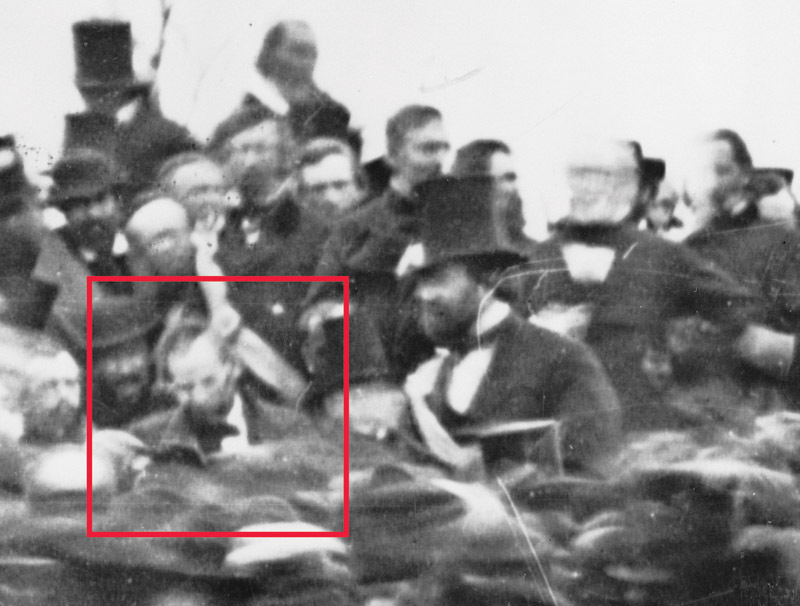
Today is the 150th anniversary of the Gettysburg Address.
Lincoln casts quite a shadow in history. There was a grand speech before Lincoln's at Gettysburg in 1863 by Edward Everett, a well-known orator.
Speaking for 2 hours and over 13,000 words Everett's speech was complex, referencing Ancient Greece and using terms in Latin. Today Everett's speech is largely "invisible."
Lincoln spoke only for 2 minutes, and his 272 words are inscribed on the Lincoln Memorial.
How the Enigma Machine worked
Murlyn Hakon of Bletchley Park explains how the Enigma Machine worked.
The remarkable thing about Enigma, is that when you press a letter on the keyboard and the subsequent enciphered letter lights up to the rear of the machine, the chances of that letter lighting up are nearly 158 million million million to 1.
(Revised and republished April 21st, 2025)
Mavis Batey: Bletchley Park codebreaker
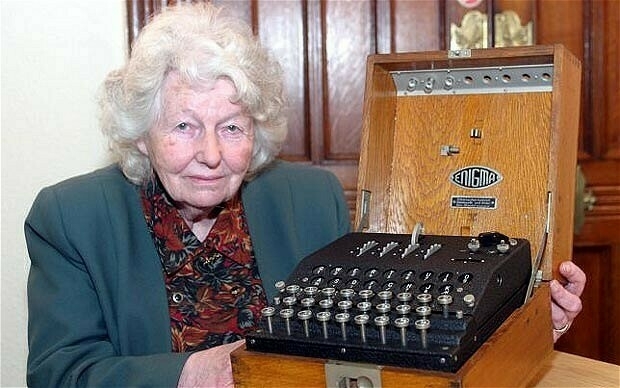
Mavis Batey was one of the codebreakers working at Bletchley Park during World War II. She recently passed away at age 92. Batey was part of the codebreaking team that ensured a successful landing for Allied forces on D-Day.
She initially worked in London, checking commercial codes and perusing the personal columns of The Times for coded spy messages. After showing promise, she was plucked out and sent to Bletchley to work in the research unit run by Dilly Knox. Knox had led the way for the British on the breaking of the Enigma ciphers, but was now working in a cottage next to the mansion on new codes and ciphers that had not been broken by Hut 6, where the German Army and Air Force ciphers were cracked. “It was a strange little outfit in the cottage,” Mavis said. Knox was a true eccentric, often so wrapped up in the puzzle he was working on that he would absent-mindedly stuff a lunchtime sandwich into his pipe rather than his tobacco: “Organisation is not a word you would associate with Dilly Knox. When I arrived, he said: 'Oh, hello, we’re breaking machines, have you got a pencil?’ That was it. I was never really told what to do. I think, looking back on it, that was a great precedent in my life, because he taught me to think that you could do things yourself without always checking up to see what the book said."
(Revised and republished April 21st, 2025)
CDH event: Animated Music Screening and Talk - May 30th
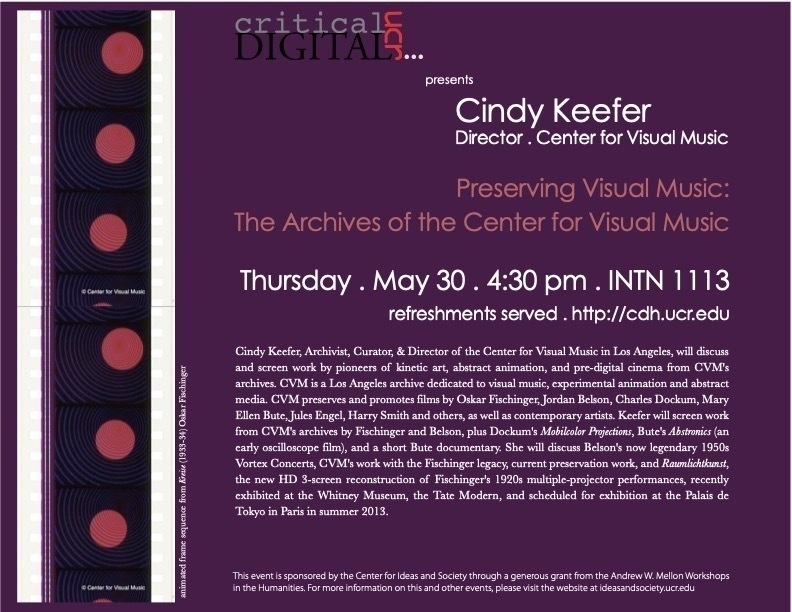
Cindy Keefer, Archivist, Curator & Director . Center for Visual Music
Preserving Visual Music : The Archives of the Center for Visual Music
THURSDAY . May 30, 2013 . 4:30 PM . INTN 1113 . Refreshments served .
Cindy Keefer, Director of the Center for Visual Music Los Angeles, will discuss and screen work by pioneers of kinetic art, abstract animation and pre-digital cinema from CVM's archives. CVM is a Los Angeles archive dedicated to visual music, experimental animation and abstract media. CVM preserves and promotes films by Oskar Fischinger, Jordan Belson, Charles Dockum, Mary Ellen Bute, Jules Engel, Harry Smith and others, as well as contemporary artists. Keefer will screen work from CVM's archives by Fischinger and Belson, plus Dockum's Mobilcolor Projections, Bute's Abstronics (an early oscilloscope film), a short Bute documentary, and more. She will also discuss Belson's now legendary 1950s Vortex Concerts, CVM's work with the Fischinger legacy, current preservation work, and Raumlichtkunst, the new HD 3-screen reconstruction of Fischinger's 1920s multiple-projector performances, recently exhibited at the Whitney Museum, the Tate Modern, and scheduled for exhibition at the Palais de Tokyo in Paris in summer 2013.
This is the last event Critical Digital Humanities will host for the 2012-2013 season. Please join us for this exciting presentation. [cdh.ucr.edu](http://cdh.ucr.edu)
(Revised and republished April 23rd, 2025)
The "3000-pound spreadsheet machine"
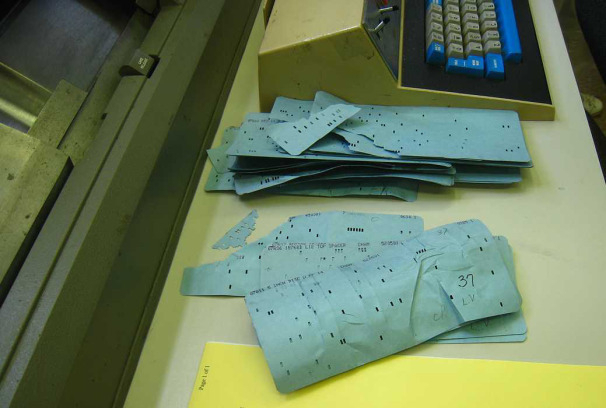
If It Ain’t Broke, Don’t Fix It: Ancient Computers in Use Today (Wayback Machine link)
Companies traditionally used the 402 for accounting, since the machine could take a long list of numbers, add them up, and print a detailed written report. In a sense, you could consider it a 3000-pound spreadsheet machine. That’s exactly how Sparkler Filters uses its IBM 402, which could very well be the last fully operational 402 on the planet. As it has for over half a century, the firm still runs all of its accounting work (payroll, sales, and inventory) through the IBM 402. The machine prints out reports on wide, tractor-fed paper.
This is pretty amazing. I’ve seen older systems in use recently, like Windows 95, but this is just extraordinary.
(Revised and republished April 21st, 2025)
Keeping TaB with diet soda
TaB soda was named by an IBM mainframe (Wayback Machine link) – now it makes sense. The name was supposed to relate to keeping “tabs” on your weight (Wayback Machine link), rather than being an acronym for “totally artificial beverage.”
To obtain a list of potential names, William Mannen, chief programmer for data processing, programmed the company’s IBM 1401 (Wayback Machine link) mainframe computer to print all possible four-letter word combinations containing a vowel or vowel-sounding letter. The results took a day to print and contained more than 300,000 possible combinations. This list was narrowed down to 600 possibilities, which were then given to the legal department to check against existing trademarks. After legal narrowed the list again, TaB was chosen from among the final two dozen contenders. Why? Because it was distinctive and easy to remember, and it projected the desired image.
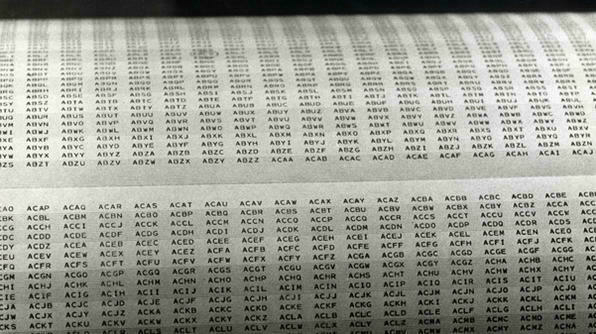
(via @melissaterras on Twitter)
(Revised and republished April 21st, 2025)
Born Digital newspaper project
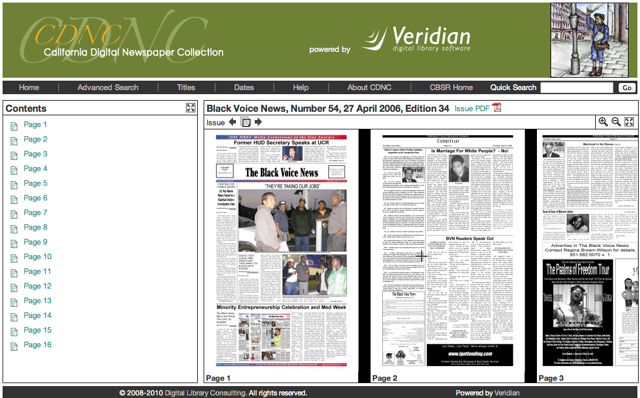
This summer I've been working on the "Born Digital" project at the Center for Bibliographic Studies and Research (CBSR) at UC Riverside. The Born Digital project is an effort to help preserve small, weekly newspapers that are currently being produced in digital formats.
While digital technology has allowed modern newspapers to be created and distributed in new and exciting ways, it has also made the records of those newspapers more fragile. The Born Digital project helps newspaper publishers preserve, and make accessible to the general public at no charge, their digital files. As an online archive, the Born Digital project is a portion of the California Digital Newspaper Collection, which holds titles from 1846 to the present.
More information about the Born Digital project is available in this UCR news article: http://newsroom.ucr.edu/2667 (Wayback Machine link)
(Revised and republished April 21st, 2025)