
teaching
Academic Digital Presence
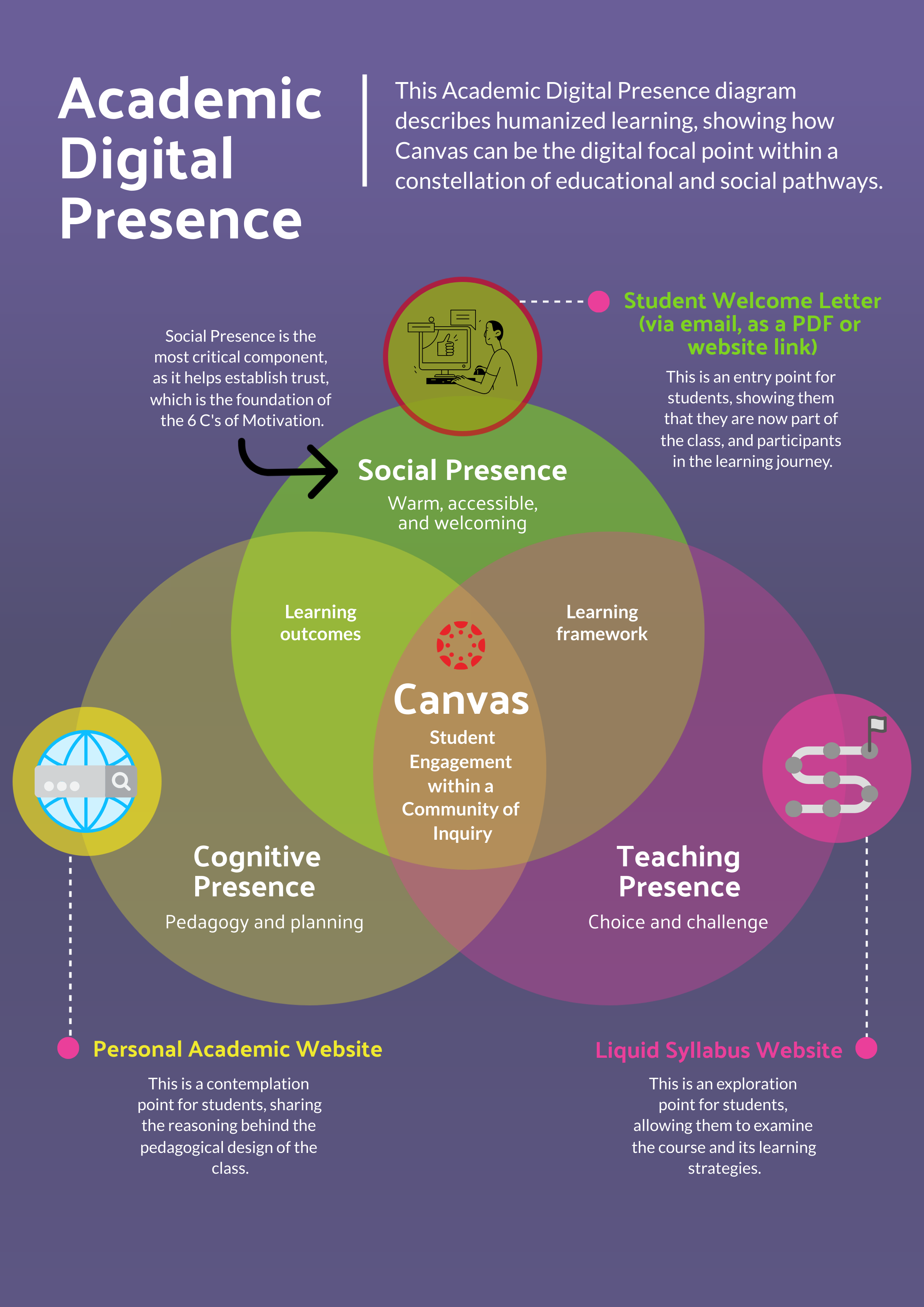
I created the infographic below for a Canvas certification course, “Humanizing Learning in Canvas.”
The course was part of the Canvas Certified Educator for Higher Education pathway.
Coyote Time and Empathetic Design
“Failure is a path, not an immediate result.”1
I was listening to ATP podcast, and John Siracusa discussed “Coyote Time.”
The idea of Coyote Time comes from Wile E. Coyote cartoons, and it’s rooted in video game design.
In the Wile E. Coyote and the Road Runner cartoons, Wile E. Coyote tends to end up just off the edge of a cliff, but he doesn’t fall until he realizes his dire situation.

At a glance, it would appear that Coyote Time is a moment of realization, a sinking feeling of impending doom. However, in video game design, Coyote Time is more about forgiveness and empathetic design choices. Coyote Time is about designing features into a game that provide a sense of reality apart from the harsh mechanics of the game itself.
In, “Coyote Time: What Games can Teach Us About Forgiveness in Learning,” Eva Grouling Snider describes Coyote Time as providing “wiggle room” and reducing frustration, which helps to “minimize the consequences of errors, mistakes, and imperfections.”
In educational design and video game design, Coyote Time can be relied on for applying both reality and unreality, a sense of authenticity or inauthenticity, with the end goal of providing engaging experiences where the student, or player, is able to perform at their best.
For example, in video games, this is often a bit of lag introduced purposefully to enable the player to perform an action, such as jumping over a difficult object. In teaching, this could be a low-stakes formative assessment, or perhaps a quiz that can be taken multiple times but only saving the highest score. In lower division courses, Coyote Time may be increased, and then gradually designed out of the course for upper division or graduate level work.
In teaching, Coyote Time can be explicit, for example, allowing drafts to be submitted for comments prior to the formal essay. Coyote Time can also be implicit, in that it’s designed into the course and woven through the educational pathways, providing layers of support while not necessarily stating the design choices.
-
Eva Grouling Snider, “Coyote Time: What Games can Teach Us About Forgiveness in Learning,” The Teaching Innovation Blog, Ball State University, Muncie, Indiana, November 15, 2023. ↩︎
Historical Discourse and Hollywood Films
The Case for Hollywood History, Francine Prose at the New York Review of Books, 2015:
It’s so much easier and less threatening to talk about whether (or how much of) a film is “true” than to confront the unpleasant—and indisputable—truth: that racial and sexual prejudice have persisted so long past the historical eras in which these films are set.
This happens quite often with student essays concerning historical films -- too much attention paid to the factual discrepancies and not enough contemplation of the larger themes. I use films in my research and teaching, they're invaluable for understanding how history has been interpreted in various ways.
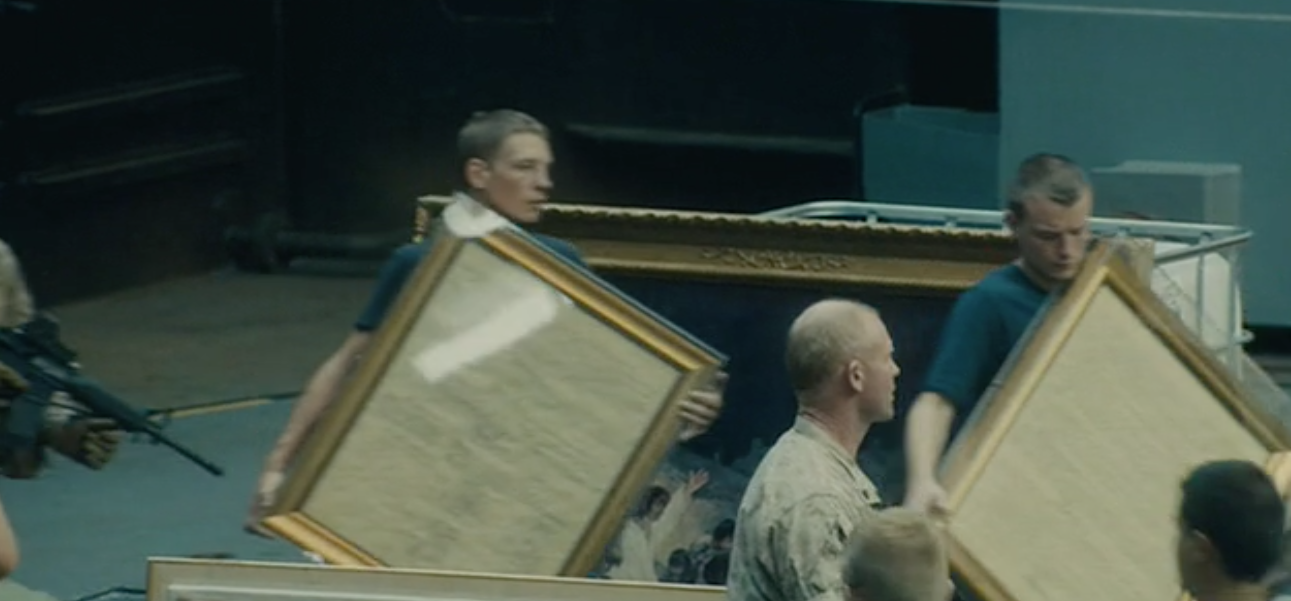
One of my favorite clips for 20th Century United States history comes from World War Z. It's the moment when people are being removed from the aircraft carrier and The Charters of Freedom are being brought on board in their place. World War Z is fictional of course, however, the human response to catastrophe, whether caused by zombies or some other force, provides a great starting point for historical discussion.
(Revised and republished April 19th, 2025)
Digital Pedagogy workshop for TAs
Ever wondered what digital pedagogy is? Want to know what it’s like to teach online?
Wonder no more.
On February 19th, 2014, join us for an introductory session on digital pedagogy.
We will introduce you to the LMS (Learning Management System) Canvas, and we'll show you some of the applications that make online teaching as good (and sometimes better) than face–2-face teaching. We’ll also discuss some of the best practices for online education in the physical classroom and in the virtual one.
Location: UC Riverside, Surge 170
Date and time: Wednesday February 19th, 2014. 4–6PM
This is the first of hopefully many sessions aimed at training graduate students (and anyone else) in digital pedagogies.
(Revised and republished April 19th, 2025)
Notes on Virtual Lectures
The virtual lecture that Professor Levy gave to her CHASS F1RST class on Monday went very well. This was the first time we attempted to produce a virtual lecture, and I’ve compiled some notes on the process and our experience.
1. The setup will take 5–10 minutes.
Professor Levy and I had both done Google Hangouts before, but never for such a large audience. Just connecting the laptop to the projector can take a minute or two, and then there’s the webcam, and the initiation of the Google Hangout. In order to keep students engaged during all this, I played the “#Hashtag” video with Jimmy Fallon and Justin Timberlake. The idea here was to inject a little humor, and also consider digital technology as a theme for the lecture. After the video, Judy (the TA), addressed the class and let them know about the video conferencing aspect via Google Hangouts.
Virtual Lectures and the Digital Classroom
This winter quarter I am a research assistant working on digital pedagogy and instruction at UC Riverside for Professor Juliette Levy. The class consists of about 60 students, and it’s a CHASS F1RST Humanities Course (Wayback Machine link) covering the history of Latin America. Even though this is a regular in-class course, we’re using a variety of digital tools to help broaden the learning experience. These tools, which are helpful for managing the class itself and also creating real interaction between students, include:
Rewiring Class Emails and Student Interaction with Piazza
In a previous post I wrote about the experience of teaching an online class as a TA. One of the primary tools we used for the course was Piazza, and it was instrumental in shifting the burden of email to a more open and constructive arena.
The back-end of online classes
In "Who is Driving the Online Locomotive," (Wayback Machine link) Rob Jenkins asks some pertinent questions about the force and direction of online education. There is definitely the feeling that something is coming, and those who aren't prepared will be lost by the wayside...or flattened by the train. However, this feeling of online education as the next-big-thing has been palpable for a couple of decades now. The latest gust of wind in the sails has been the infamous MOOC, but it's really more about the intersection of budget cuts and the ubiquity of social networking. It's also very unfortunate that there is usually little discussion of the differences between types of online classes – a MOOC with thousands of participants is a very different thing from a small online-class of 40 students.
Map of the Inca Empire
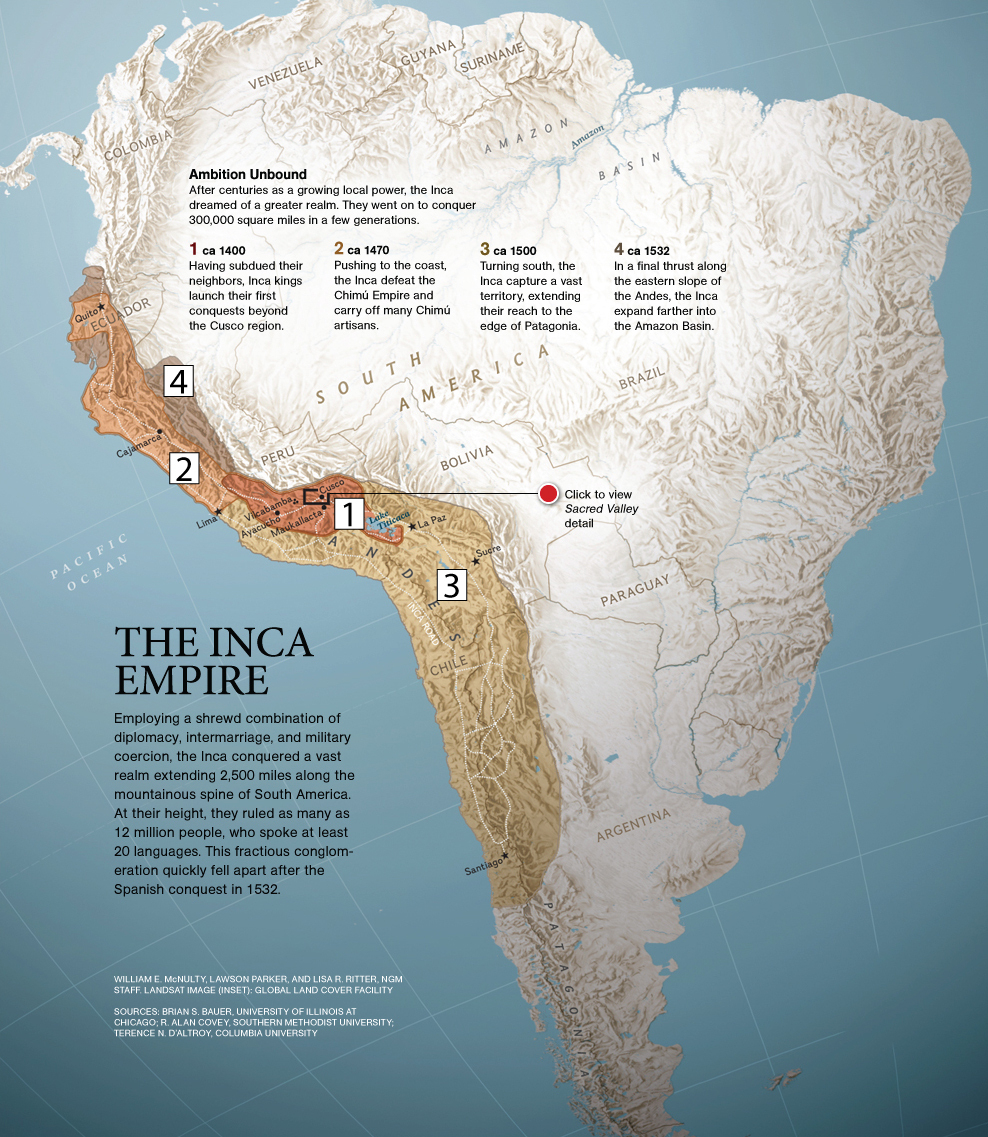
This map of the Inca Empire (Wayback Machine link) is great for showing the rapid expansion of the Incas across the Andes region. On the original map it was a little difficult to correlate the numbered excerpts with the colored regions, so I made new numbers that will show up a little better on classroom projectors.
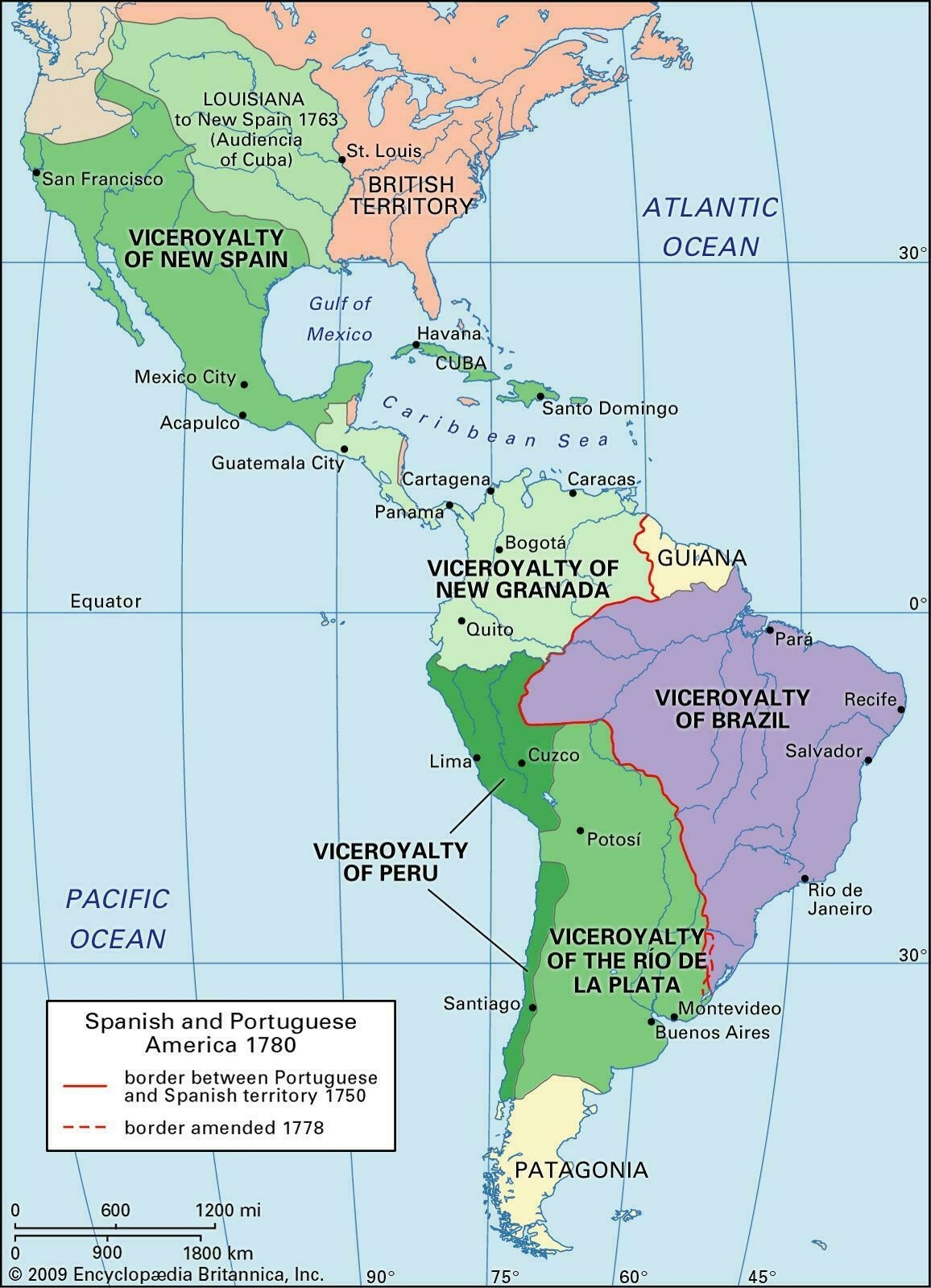
Map of Spanish Viceroyalties
I came across this map of Spanish viceroyalties (link no longer available) a few months ago, and since it can be difficult to find good maps online I thought I'd post it here. Even though there's a plethora of maps on the Internet, it still seems like the best ones are either overhead-projector transparencies, or printed in books. This map is of Spanish territory in the Americas during the eighteenth century – it covers all of Latin America and the Spanish-American colonial empire, as well as neighboring British territory, and the Portuguese viceroyalty of Brazil.
The Spanish viceroyalties shown on the map are:
- Viceroyalty of New Spain
- Viceroyalty of New Granada
- Viceroyalty of Peru
- Viceroyalty of the Río de la Plata
(Revised and republished April 21st, 2025)