
Just a Little Acronym We Thought Up
xkcd comic on Douglas Engelbart and the "Mother of All Demos" in 1968
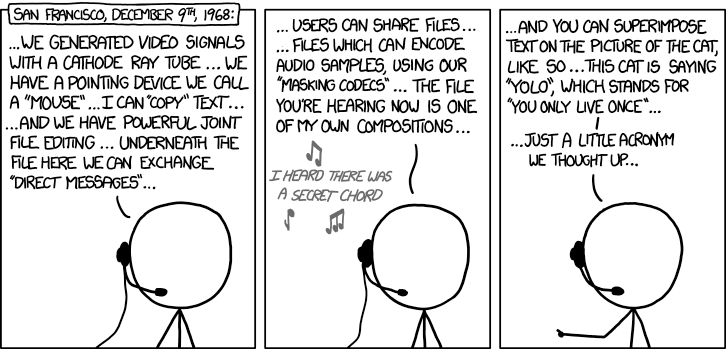
The video below is the “Mother of All Demos” at the Internet Archive
1968 Demo - FJCC Conference Presentation Reel #1 by SRI International
(Revised and republished April 2nd, 2025)
It Looks Like 20 Feet
If only I had this when I was still riding ramps!
www.youtube.com/watch?v=MNL9kuWwFes (video no longer available)
NYTimes on Jim Parsons and Intel advertisements.
How Deep is Your Photography? by Intel (and Jim Parsons)
The three cameras shoot simultaneously, then combine the overlaid information to create an image file that has many more capabilities than a standard JPEG. Once an image is captured, it is processed into a high-quality, depth-mapped file.
“It creates a fat JPEG,” said Erhhung Yuan, system architect and lead developer for Intel RealSense snapshot. “It’s essentially a JPEG with more metadata fields, including the computed depth map.”
The ad is pretty cheesy, but the technology looks interesting. I can see smartphones having more cameras on the backside, and the “fat JPEGS” will require faster processors, more storage, and so on, pushing the limits of the devices even more.
(Revised and republished April 13th, 2025)
5 MB of Data on 62,500 Punched Cards

“Programmer standing beside punched cards” “This stack of 62,500 punched cards — 5 MB worth — held the control program for the giant SAGE military computer network.” ca. 1955 (via the Computer History Museum)
Explaining data storage in a visual way has always been difficult, but especially so with the transition to magnetic tape in the 1950s and 1960s.
Photographs of punched cards help show the enormity of the task at hand, and also the materiality of the information.
5 megabytes of data seems pretty insignificant nowadays, when terabyte hard drives are a common feature in personal computers.
1 TB = 1,000,000 MB (now that would be a lot of punched cards!)
From the Computer History Museum’s online exhibit on Memory and Storage.
(Revised and republished April 2nd, 2025)
Punch Card Jam Needs Some Force
In 2010, representatives from the Computer History Museum visited a company in Texas still using an IBM 402 mainframe for everyday accounting jobs: http://ibm–1401.info/402.html
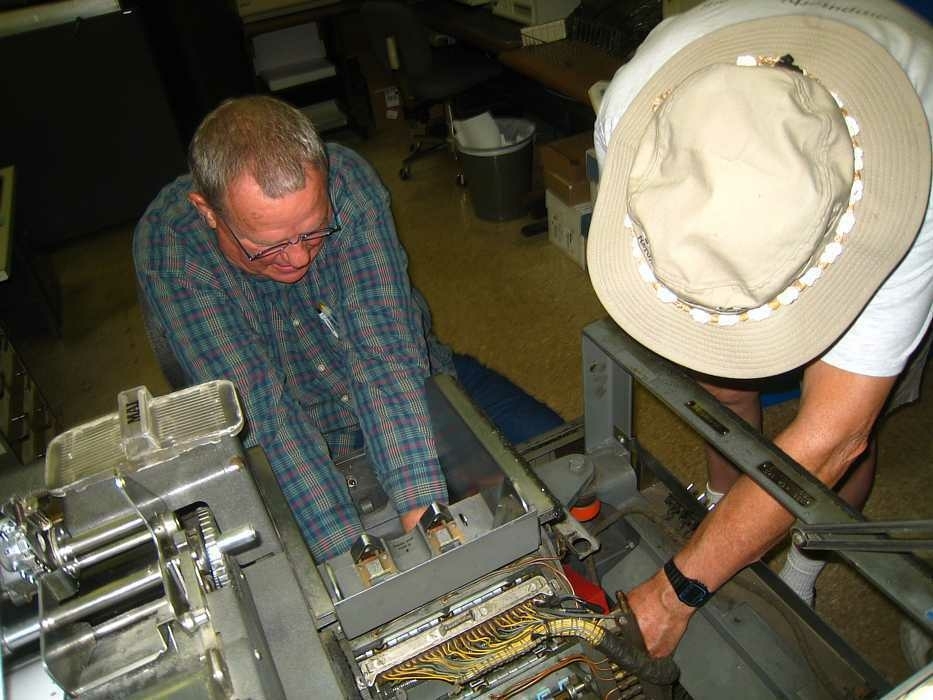
“Jam needs SOME force”
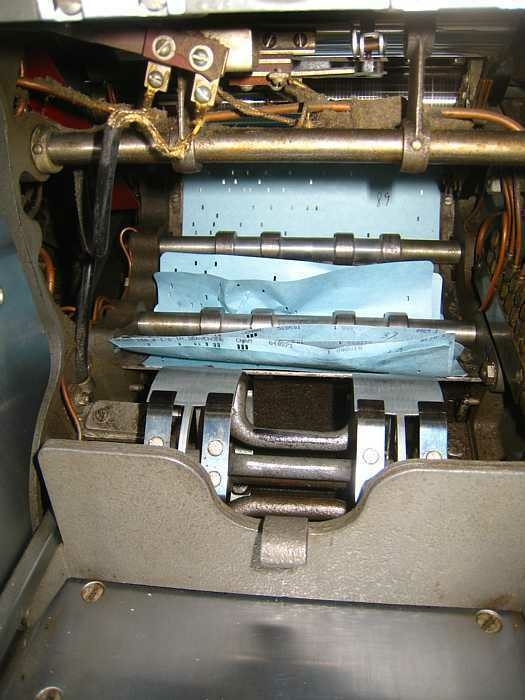
“Card Jam Front View”
The article below mentions the CHM trip to Texas, and a few other old computers still in use:
If It Ain’t Broke, Don’t Fix It: Ancient Computers in Use Today, by Benj Edwards at PCWorld, 2012 (Internet Archive: Wayback Machine)
The biggest problem with maintaining such ancient computer systems is that the original technicians who knew how to configure and maintain them have long since retired or passed away, so no one is left with the knowledge required to fix them if they break.
(Revised and republished April 2nd, 2025)
Mainframes are so 50 years ago
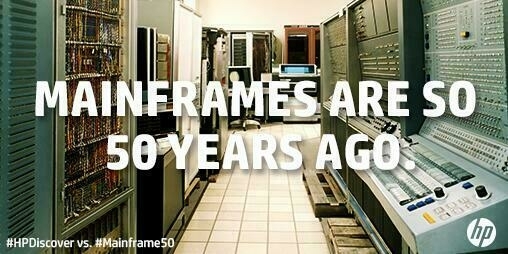
I came across this tweet as an advertisement in my own Twitter feed. It’s meant to be ironic, mainframes are still around, it’s more so the way they’re perceived that’s changed.
twitter.com/hpdiscover/status/453556126043615232 (Twitter links no longer available)
The comments are funny too:
@HPDiscover
this is SO not true. Shame on you HP.
#bigdata
— Camila Caldas (@camilaclbcaldas)
April 8, 2014
@HPDiscover
Another one who will eat his words about the death of the Mainframe. Here we go again !!! Have u even watched Matrix ? LOL!! — DD (@Cojinua77)
April 9, 2014
(Revised and republished April 2nd, 2025)
Computers Never Lie About Love
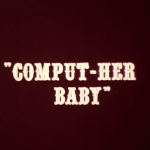
“Comput-Her Baby” - a short film by Dave Goldson and Neal Chastain, 1968
A satire on computer dating and matchmaking. The song “Strangers in the Night” plays while punched cards are sorted by mainframe computers.
The color in the Vimeo embed below (sadly, no longer available) is a bit off, toward a faded, pinkish hue. The video is available at UC Berkely and UC San Diego, but I’m not sure of the condition of those reels. It’s also listed at the UCLA Film and Television archive in faded condition.
(Revised and republished April 2nd, 2025)
The Machine That Changed the World - video series
Thanks to Andy Baio, all five parts of The Machine That Changed the World are available online: http://waxy.org/2008/06/the_machine_that_changed_the_world/
The Machine That Changed the World is the longest, most comprehensive documentary about the history of computing ever produced, but since its release in 1992, it's become virtually extinct. Out of print and never released online, the only remaining copies are VHS tapes floating around school libraries or in the homes of fans who dubbed the original shows when they aired.
All 5 episodes are (sort of) available on YouTube.
The YouTube videos are blocked now, “on copyright grounds,” but they still play after a moment.
(Revised and republished April 2nd, 2025)
I Desire to Become Data
Fragments on Machines, a film by Emma Charles
An interesting and very artistic take on the materiality of digital culture, and the physical structures that support modern communication, computation, and data storage. The ventilation covers and shafts in the beginning of the video seem so mundane, but just a few steps inside is an entire world of noise and movement.
My muscle has been replaced by flex and copper. My brain a server. Ones and zeros my voice. I exist as a phantom, an iridescent color. I speak in shimmering tones to the hidden construction of the form. I desire to become data.
(Revised and republished April 13th, 2025)
Digital Archaeology at The Deleted City
In an heroic effort to preserve 10 years of collaborative work by 35 million people [Geocities], the Archive Team made a backup of the site just before it shut down. The resulting 650 Gigabyte bit-torrent file is the digital Pompeii that is the subject of an interactive excavation that allows you to wander through an episode of recent online history.
(Revised and republished April 13th, 2025)
Outside the Spacecraft - NASM
Outside the Spacecraft, an interactive museum exhibit at the Smithsonian National Air and Space Museum. High resolution photographs, insight into curation and preservation techniques, even checklists and paperwork.
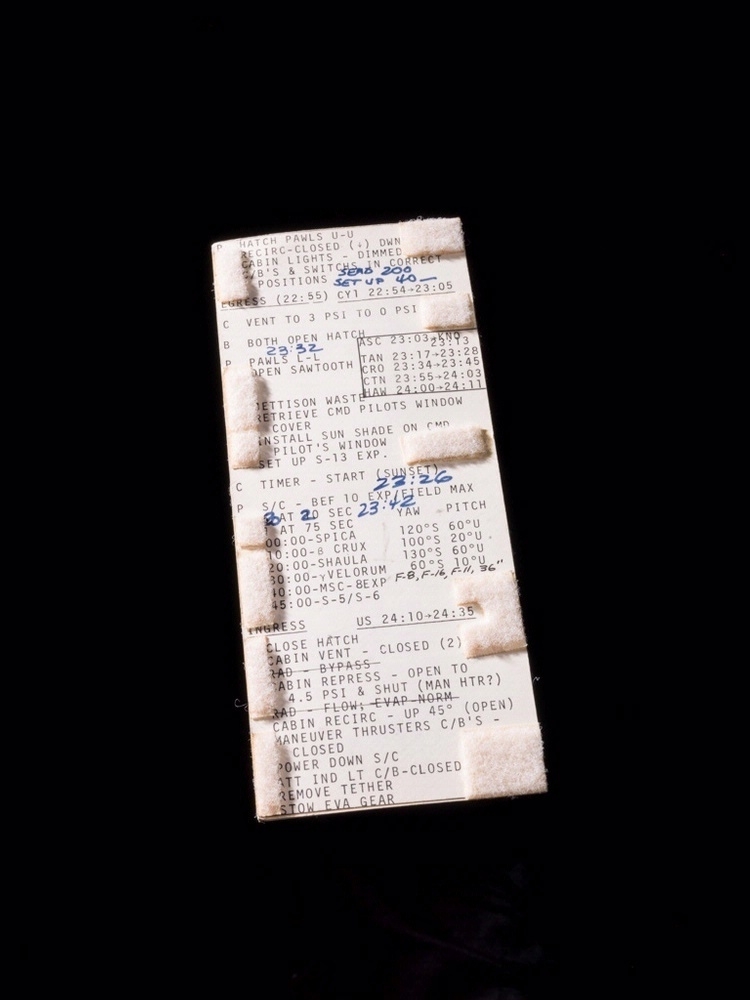
The exhibit reminded me of this recent tweet by The Onion:
Otherwise Reasonable Man Sincerely Believes U.S. Landed On Moon: The Onion
(@TheOnion)
February 17, 2015
(Revised and republished April 13th, 2025)