
Archive Team - Robots.txt is a suicide note
ROBOTS.TXT is a stupid, silly idea in the modern era. Archive Team entirely ignores it and with precisely one exception, everyone else should too.
Archive Team interprets ROBOTS.TXT as damage and temporary madness, and works around it. Everyone should. If you don’t want people to have your data, don’t put it online.
(Revised and republished April 2nd, 2025)
The Holmdel Computer Center - Part 2
The Holmdel Computer Center, Part 2 – AT&T Archives (Wayback Machine link)
This rare look inside a Bell Labs computer center, specifically the one at the Holmdel location, which was referred to internally as the “HOCC” or the “HO CC”. This film was made as orientation for new employees who would need to use the computer center, and this, part 2 of 2 (see part 1), is about the programming center within the HOCC. One thing that’s notable about this film — different from Part 1 — is the preponderance of women working in the Programmer Services area. Around 1966, 7 years before this film was made, there were over 500 women working in “technical work” at Bell Labs, rather than administrative work, and many were in computing. A book and blog by Nathan Ensmenger examines the sociological history of computing, and why during the 1980s the computing field became more and more the province of men. Stories about women in the early decades of computing still reside in the world of the personal anecdote; it’s hard to assess the exact data on how many women worked in the field in the 1960s and 1970s.
The original video isn’t available on the Wayback Machine, but the YouTube version is embedded below.
(Revised and republished April 2nd, 2025)
The Holmdel Computer Center - AT&T archives
There’s some interesting artwork on the timeshare computer…reminds me of the “nose art” on military aircraft. In my archival research I’ve come across a few instances of pinup-style material, especially ASCII art printouts.
The video below is from 1973, slightly after the timeframe of my research, but certainly interesting.
The Holmdel Computer Center, Part 1 – AT&T Archives (Wayback Machine link)
The year was 1973, and the computer operating system UNIX, invented at Bell Labs by Ken Thompson and Dennis Ritchie, had just morphed into its third iteration or improvement, and had just been rewritten in the C programming language. This film, made as an orientation for the computer center at the Bell Labs Holmdel location, is a rare glimpse into the operations and procedures of an early 1970s research-oriented computing center. And as the 1973 Holmdel Computer Center only had IBM computers, it wasn't running a UNIX installation: the system was only ported to IBM computers in the years to come. In 1973, UNIX as a system was limited to installations on DEC computers, and there were UNIX installations at other locations of Bell Laboratories such as Indian Hill, Whippany, and, of course, Murray Hill (where UNIX and C were developed). Computers in the Bell System weren't just relegated to computer science or the development of computer language. They were employed for all kinds of complex engineering calculations, telecommunications applications, and, very occasionally, for making art and music.
The original video isn’t available on the Wayback Machine, but the YouTube version is embedded below.
(Revised and republished April 2nd, 2025)
Fred Soper - Wikipedia
I happened across an historical US passport for Fred Soper (1893-1977), the American epidemiologist and public health administrator, while doing some research on paperwork. The National Library of Medicine has a page on Fred Soper under their "Profiles in Science" project, but Soper's Wikipedia page is quite lacking (updates have been made since 2015). Updating Wikipedia for this historical figure would make a great project for a History and/or Digital Humanities class. There's also a listing of primary visual sources, with high resolution images.
(Revised and republished April 13th, 2025)
Historical Discourse and Hollywood Films
The Case for Hollywood History, Francine Prose at the New York Review of Books, 2015:
It’s so much easier and less threatening to talk about whether (or how much of) a film is “true” than to confront the unpleasant—and indisputable—truth: that racial and sexual prejudice have persisted so long past the historical eras in which these films are set.
This happens quite often with student essays concerning historical films -- too much attention paid to the factual discrepancies and not enough contemplation of the larger themes. I use films in my research and teaching, they're invaluable for understanding how history has been interpreted in various ways.
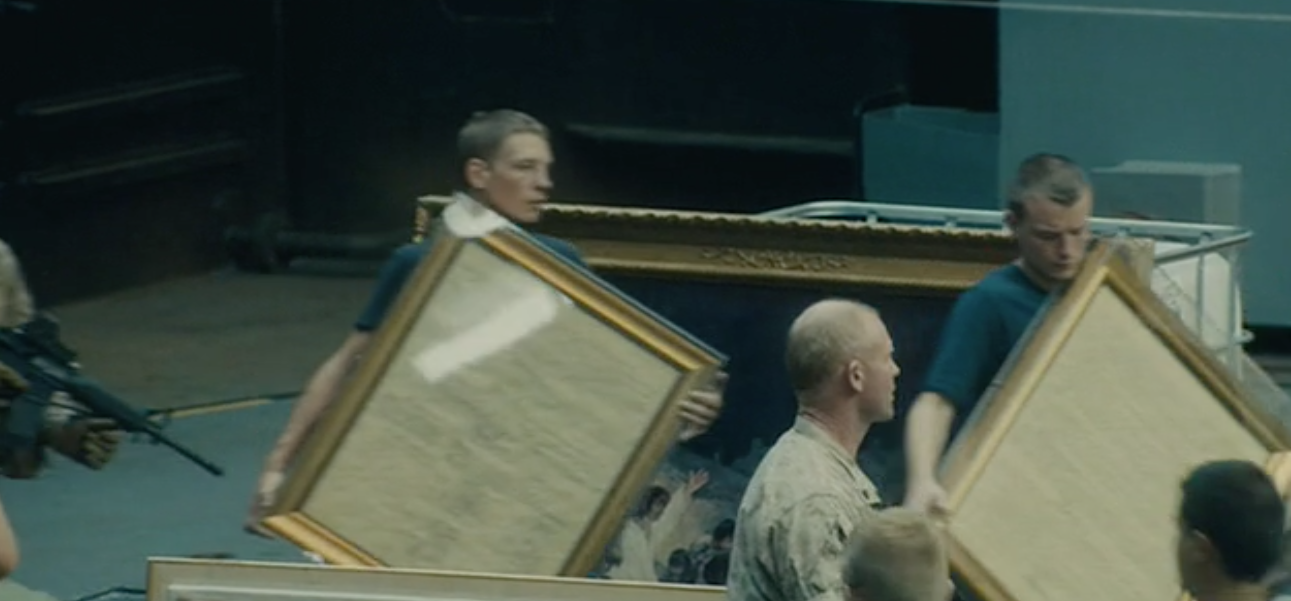
One of my favorite clips for 20th Century United States history comes from World War Z. It's the moment when people are being removed from the aircraft carrier and The Charters of Freedom are being brought on board in their place. World War Z is fictional of course, however, the human response to catastrophe, whether caused by zombies or some other force, provides a great starting point for historical discussion.
(Revised and republished April 19th, 2025)
Control Data Cyber 170 mainframes
Two Control Data Cyber 170 mainframe computers, side by side – one online, and one as a spare. (Photograph via Library of Congress)
SITE BUILDING 002 - SCANNER BUILDING - LOOKING AT DISC STORAGE SYSTEMS A AND B
The year on the photo is listed as 1999, which seems too recent given the feel of the picture. In the high-resolution TIFF, however, the date can be seen on the bulletin board, “21 Oct 99”. The Cyber 170 was produced in the late 1970s, so this unit is at least 20 years old.
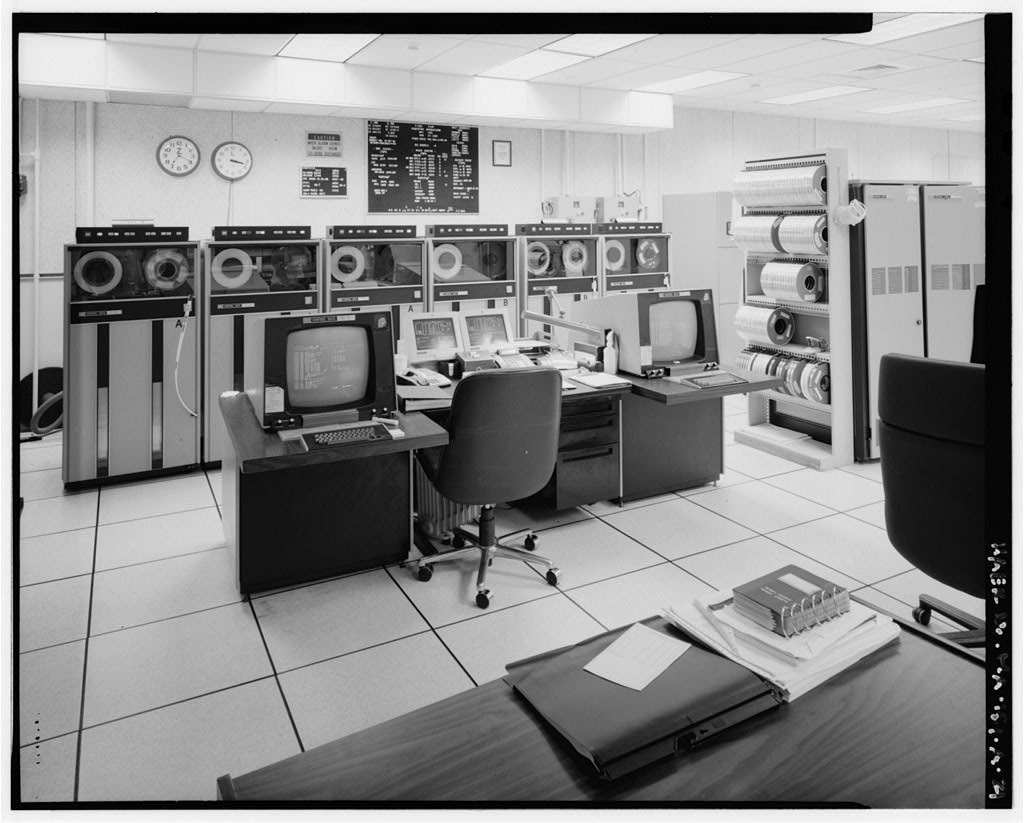
The photograph is part of this collection at LOC: Cape Cod Air Station, Technical Facility-Scanner Building & Power Plant, Massachusetts Military Reservation, Sandwich, Barnstable County, MA
(Revised and republished April 2nd, 2025)
Careers and Digital Lifespans
Campus digital workhorse running final laps after 35 years (Wayback Machine link), by Barbara Palmer, Stanford Report, 2003:
The remarkable thing is not that the mainframe will be retired -- the 35-year-old system is "like a jet slowly losing its engines," said Dick Guertin, a software developer who has worked at Stanford since 1970. What is amazing, say those whose work lives have spanned much of the computer revolution, is that the mainframe system and the ground-breaking applications designed here to run on it have held up so well for so long.
At its peak, there were 30,000 accounts, including noncampus users, on the mainframe. Some of what McWilliam is doing requires real detective work, since many of the people who opened the accounts have long ago left Stanford or retired.
Also – Forsythe Mainframe Retirement (Wayback Machine link):
The mainframe era officially ended on December 15, 2003 when the last of the mainframe accounts was closed down.
(Revised and republished April 2nd, 2025)
It was physically demanding labor
Hello, Goodbye - CDS Bids Farewell to Mainframe, Ushers in New Beginning
In 1998 the Catalog Distribution Service of the Library of Congress shutoff its mainframe computer and switched to a new system.
During the 1970s, the mainframes were used primarily to print catalog cards, which CDS once produced by the tens of millions. In those early days, as many as 30 staff members were required simply to service the units, performing such tasks as changing tape reels, threading tape and programming. "It was physically demanding labor," said Mr. Billingsley.
(Revised and republished April 2nd, 2025)
Digital Matisse
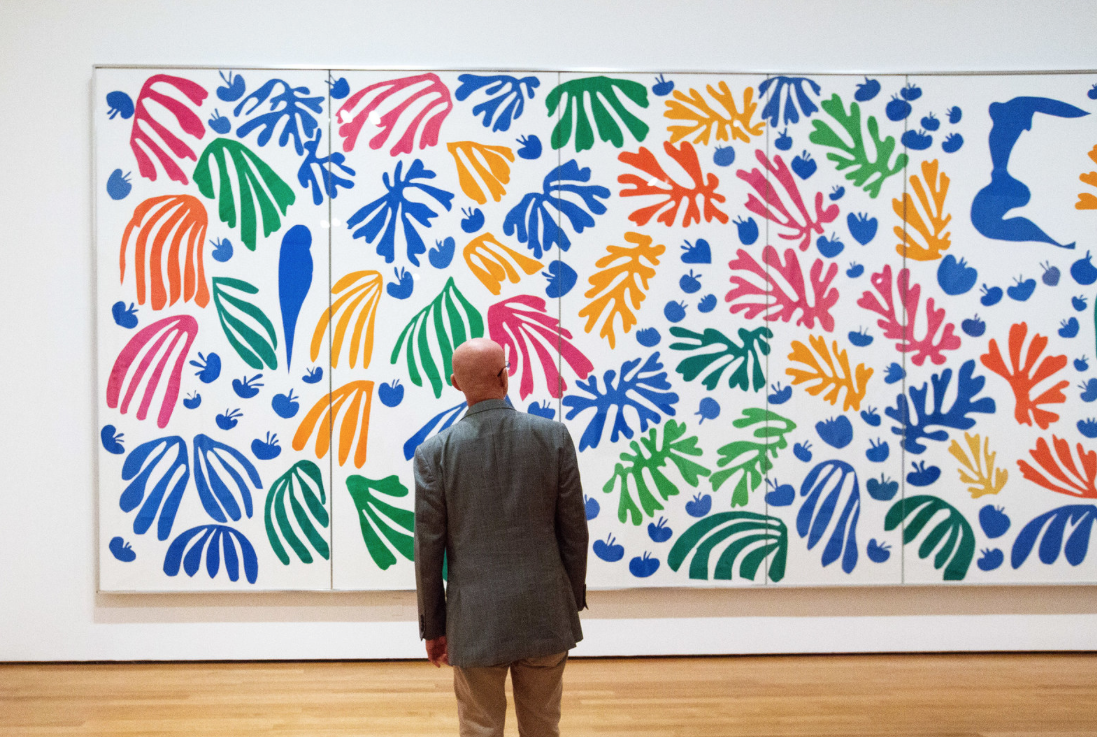
Speaking of museums and their digital presence, MoMA has an interactive exhibit covering their recent Matisse exhibition. I was lucky enough to be in New York for the AHA conference in early January, and I was able to see "Henri Matisse: The Cut-Outs" before it ended. Photography was not allowed inside the exhibit, though, so the images here are from the web. The New York Times also has an interactive Matisse "walk through." It functions as an active panoramic image, whereby you can scroll as though you were walking through the exhibit at MoMA.
Both of these interactive digital projects are wonderful, but of course nothing compares to viewing the artwork in person. I was surprised to see how large and expansive the cut-outs were, like The Parakeet and the Mermaid (over 11 feet high, and over 25 feet wide).
UCLA Differential Analyzer - 1948 film
UCLA’s 1948 Mechanical Computer Was Simply Gorgeous To Watch in Action (Wayback Machine link), by Matt Novak at Paleofuture, 2013.
I’ll need to get more information on the film clip’s provenance – it’s shown here through Gizmodo’s Vimeo channel without a source reference. It’s listed in the Paleofuture article as released by Popular Science via Paramount Pictures, 1948 (possibly through Shields Pictures Inc.).
More information at UCLA, Historical Research Highlights, “The Thinking Machine”
In December of 1977, the last working model of a mechanical differential analyzer in the world is donated by UCLA to the Smithsonian Institution for its pioneering computing display. The differential analyzer introduced much of Southern California industry to automatic computing, but became obsolete beginning in 1960 as it was replaced by computing machines with electronic circuits and vacuum tubes. From 1960 on, it was used mainly as a display piece, clanking away occasionally for student and public demonstrations.
Two more video clips of the UCLA differential analyzers at the Computer History Museum: http://www.computerhistory.org/revolution/analog-computers/3/143
(Revised and republished April 2nd, 2025)