
Files and Folders Before Computers
Filing Cabinets, a Neglected Piece of Business History, by Linda Gross, the Hagley Library:
Dr. Robertson is an associate professor of media history at Northeastern University. He explained to us that he is currently researching the early history of the filing cabinet (1890s-1930s). Robertson contends that the filing cabinet has been largely neglected in the history of information technologies, with punch card machines (a clearer precursor to computers) taking a leading role in histories of early 20th century information technologies—this despite the importance of “files” and folders” to how we organize information on computers.
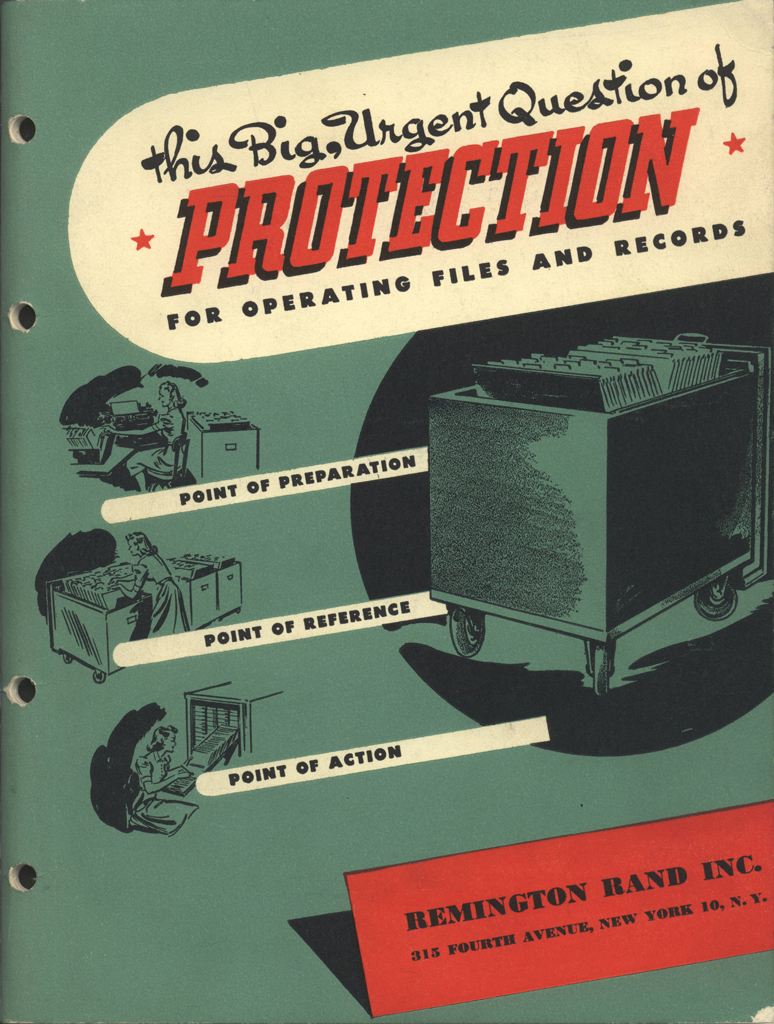
“This Big, Urgent Question of Protection for Operating Files and Records,” Remington Rand Inc. brochure, ca. 1948, Hagley Digital Archives.
(Revised and republished April 2nd, 2025)
Matthew Kirschenbaum - Track Changes
Kirschenbaum’s Tumblr blog on his book project - http://trackchangesbook.tumblr.com
Matthew Kirschenbaum’s Literary History of Word Processing, Harvard University Press blog post:
It’s interesting to see how Kirschenbaum’s research on the effects of one technological innovation—word processing—is being so shaped by his own embrace of another, social networking. Until recently, it wasn’t often that we got to watch research unfold so publicly, but Kirschenbaum’s style of transparent, internet-based process documentation is becoming more and more common, especially among practitioners of the digital humanities.
Over the years I’ve used WordStar, WordPerfect, Microsoft Word, and many other word processing programs. At the moment I’m moving to Scrivener for larger projects like my dissertation, and Apple Pages for everyday writing. (In 2025, this has changed quite a bit!)
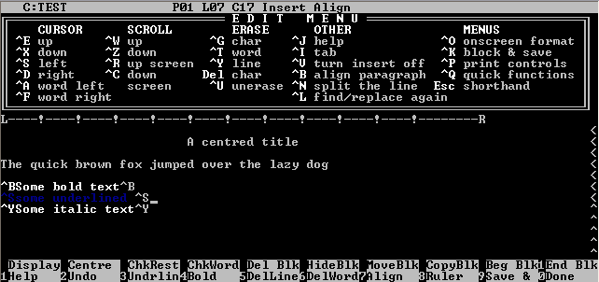
WordStar running in DOS, ca. 1980s (via Wikipedia)
(Revised and republished April 3rd, 2025)
Gladwell on the Social Life of Paper
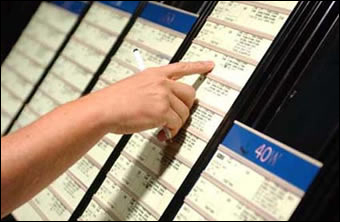
Paper strips shown at faa.gov (Wayback Machine link)
Malcolm Gladwell’s 2002 article on paperwork at The New Yorker.
“The Social Life of Paper” (Wayback Machine link)
Gladwell.com link: http://gladwell.com/the-social-life-of-paper/ (Wayback Machine link)
It is only if paper’s usefulness is in the information written directly on it that it must be stored. If its usefulness lies in the promotion of ongoing creative thinking, then, once that thinking is finished, the paper becomes superfluous. The solution to our paper problem, they write, is not to use less paper but to keep less paper. Why bother filing at all? Everything we know about the workplace suggests that few if any knowledge workers ever refer to documents again once they have filed them away, which should come as no surprise, since paper is a lousy way to archive information. It’s too hard to search and it takes up too much space. Besides, we all have the best filing system ever invented, right there on our desks — the personal computer. That is the irony of the P.C.: the workplace problem that it solves is the nineteenth-century anxiety.
(Revised and republished April 3rd, 2025)
Museums and Digital Presence
It’s wonderful to see museums considering their digital presence as an extension of their purpose – online exhibitions and other digital projects greatly enhance the collections. This article at The New York Times describes the interconnectivity between museums and visitors that the digital provides, and also the possibility of connection between museums themselves:
Sooner or later, all museum websites will be interconnected, so that any museum might take advantage of scholarship produced by any other. There’s no reason, after all, that the Museum of Modern Art shouldn’t link its Jackson Pollock page to Pollock pages of museums throughout the world.
...Where is all this going? The British Museum has a succinct answer in the concluding sentence of its About Us page: “The website is not merely a source of information about the collection and the museum, but a natural extension of its core purpose to be a laboratory of comparative cultural investigation.”
I visited the “Contested Visions in the Spanish Colonial World” exhibition at LACMA a few years ago, and thanks to their digital archive of the exhibit I’m able to share videos like this with my students.
(Revised and republished April 19th, 2025)
Q & A with Craig Robertson on The Passport in America
Craig Robertson, by Christopher Klein at the Boston Globe, 2013.
The assumption behind the system set up after World War I was that you needed an identity document. Of course, this is a time when very few people had driver’s licenses, so the birth certificate was the key document. The US didn’t achieve universal birth registration until 1933, however, and in 1942 the Census Bureau estimated that 40 percent of Americans still lacked birth certificates. So the State Department required those without birth certificates to get sworn statements from one of three people who was deemed to have been able to witness the birth: the mother, a doctor, or a midwife. And if none of those three were available, a friend who was a US citizen had to vouch for your citizenship. So you were no longer seen as a reliable source of your own identity. You needed someone else to verify it.
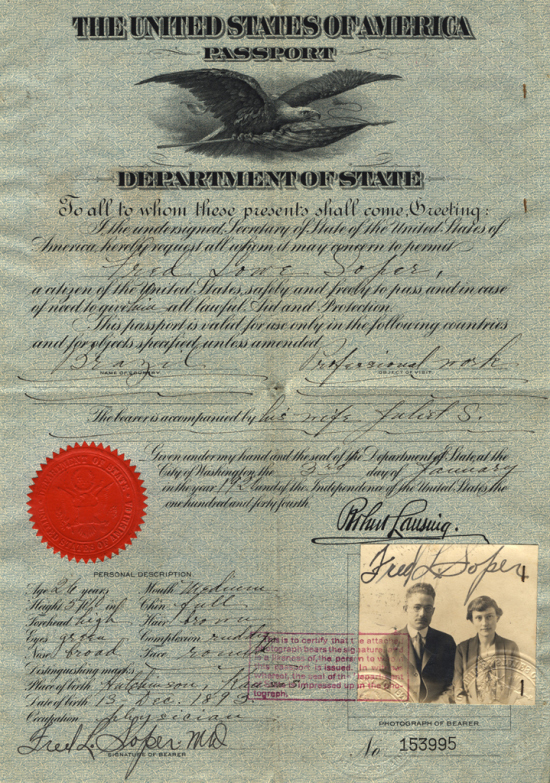
United States Passport for American epidemiologist, Fred Soper, 1920. National Library of Medicine revised 2025 link, image doesn't seem to load. Wayback Machine link for image.

(Revised and republished April 3rd, 2025)
Paperwork Studies as an Historical Field
The Paper Trail Through History (NYTimes gift link), by Jennifer Schuessler, the New York Times, 2012:
Ms. Gitelman’s argument may seem like an odd lens on familiar history. But it’s representative of an emerging body of work that might be called “paperwork studies.” True, there are not yet any dedicated journals or conferences. But in history, anthropology, literature and media studies departments and beyond, a group of loosely connected scholars are taking a fresh look at office memos, government documents and corporate records, not just for what they say but also for how they circulate and the sometimes unpredictable things they do.
(Revised and republished April 3rd, 2025)
Project poster and talk last October
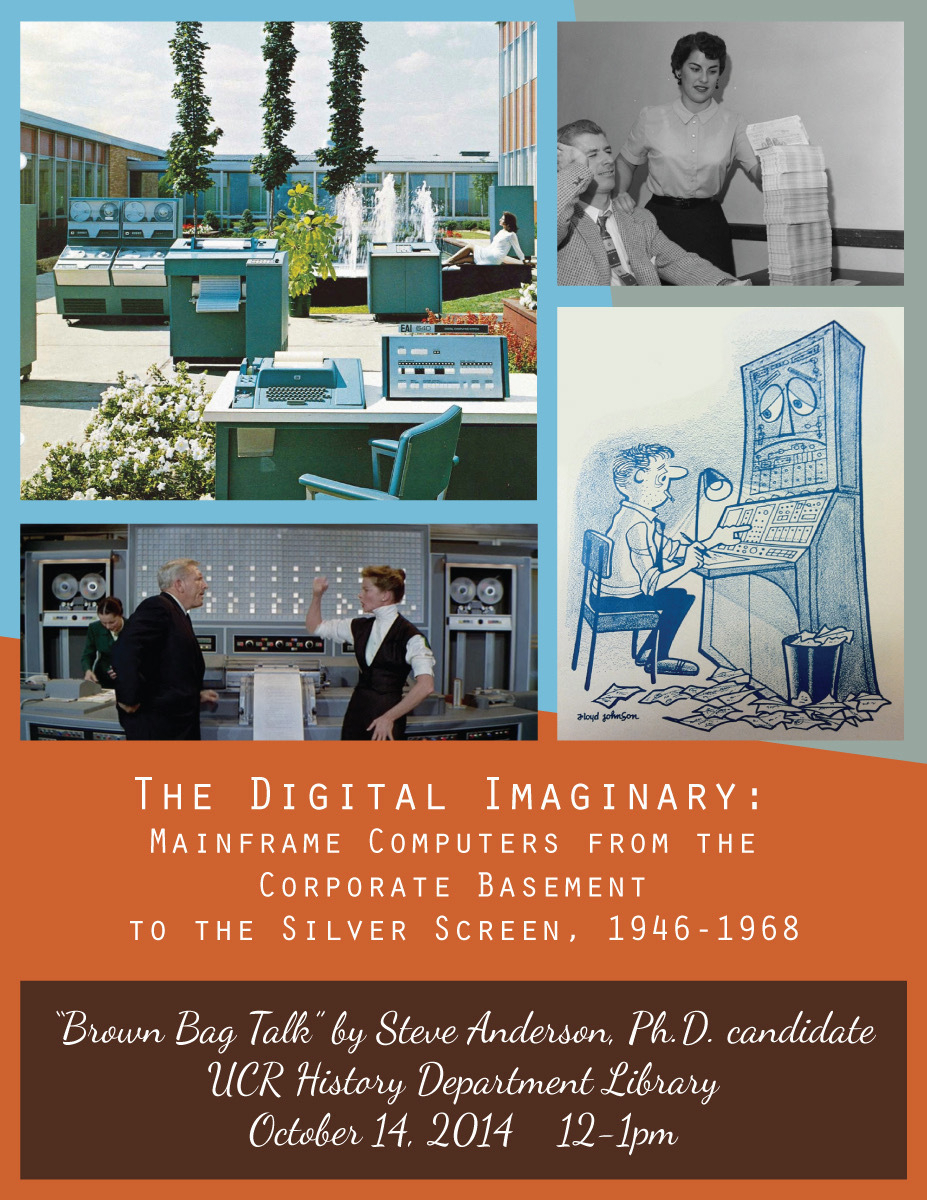
Last October I gave a “brown bag” talk (Wayback Machine link) over lunch in the History Department Library at the University of California, Riverside. I spoke for about 40 minutes and gave a wide overview of my project, using images and video clips to help illustrate my research. It was a great turnout of both professors and graduate students, and I received some terrific feedback that I was able to use for future talks.
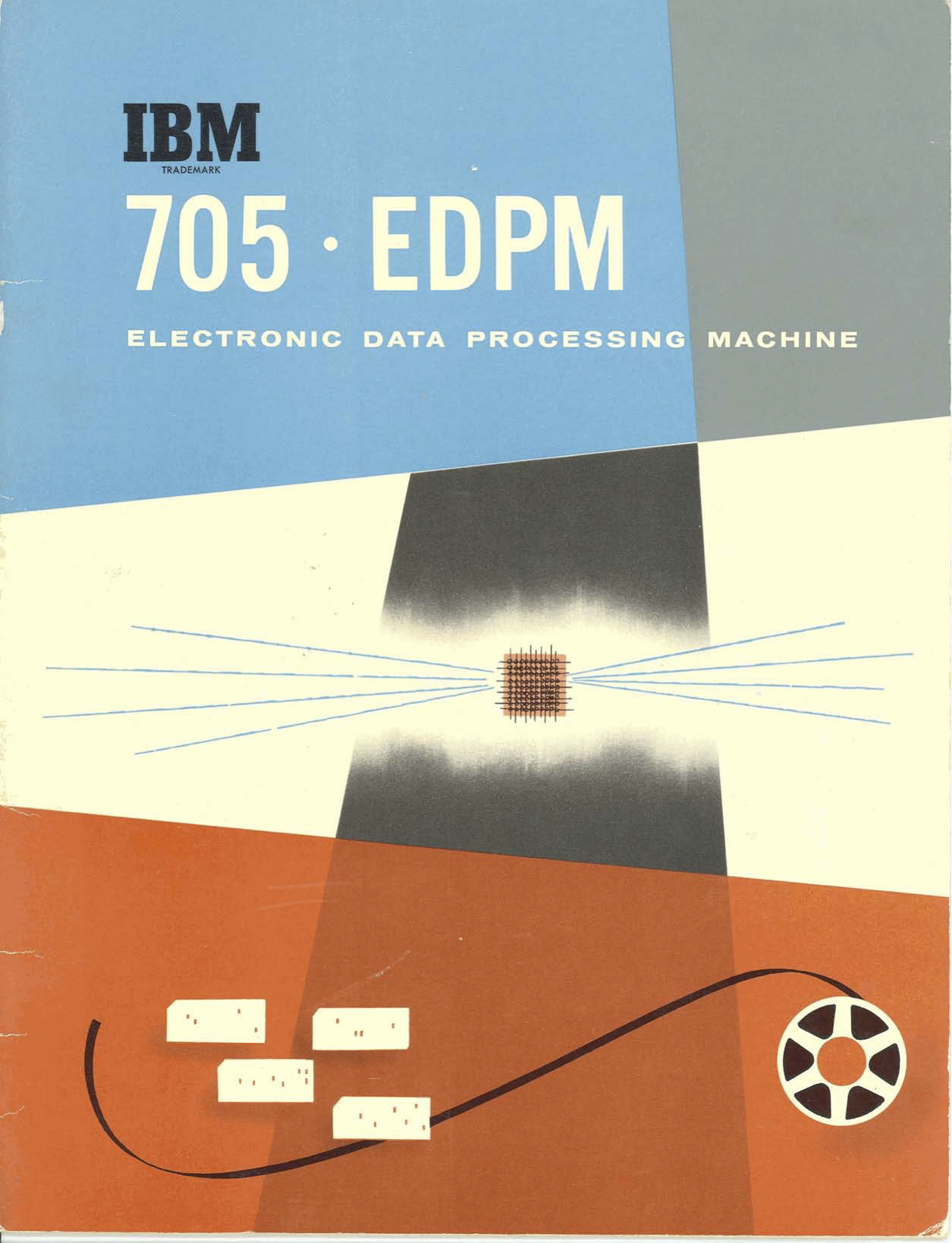
At the top is the poster I created for the talk at UCR, and the images come from a variety of primary source materials. The inspiration for the color scheme comes the brochure cover just above, which is featured in the online exhibit, “Selling the Computer Revolution,” at the Computer History Museum in Silicon Valley.
The brochure is for an IBM 705 EDPM (Electronic Data Processing Machine), a mainframe computer produced in the mid 1950s. Mainframes like the IBM 705 were powerful workhorses in the business world during the postwar era, handling payroll for thousands of employees. The brochure’s cover features a computer processing unit at the center, with punched cards and magnetic tape for data storage.
(Revised and republished April 6th, 2025)
Paperwork Explosion
This video, created by Jim Henson in 1967 for IBM, makes a great first post. So much anxiety, so little time, if only there was someone to help…like IBM!
Ben Kafka discusses this video in the Conclusion of his book, The Demon of Writing: Powers and Failures of Paperwork (2012), and also in this online West 86th article (Wayback Machine link):
The “paperwork explosion” expresses both a threat and a wish. The threat, of course, is that we are being overwhelmed by paperwork’s proliferation, its explosion — a threat that historian Ann Blair has recently traced through the early modern period. The wish is to convert all this cumbersome matter into liberating energy, which is exactly what explosions do. From Chaptal’s “electric fluid” to IBM’s “Machines Should Work, People Should Think” to USA.gov’s “Government Made Easy,” we remain attached to the idea that someday, somehow, we can liberate this energy, put it to other uses.
The “liberating energy” that Kafka speaks of also requires containment, it needs direction and control, services which IBM was ready to supply.
Two other aspects of paperwork which I’m researching are: (1) the degree to which IBM was instigating the “paperwork explosion” itself, where was it coming from, who else was worried about it, and (2) how the militaristic response to the demands of paperwork figure into the Cold War environment.
(Revised and republished April 6th, 2025)
My post on Wikipedia Edit-a-thons at NCPH Public History Commons
A few months ago, I wrote about a Wikipedia Edit-a-thon workshop at the UCR Library on the CDH (Critical Digital Humanities) and HGSA (History Graduate Student Association) websites. From these posts I was approached by Amy Tyson of the National Council on Public History's History@Work blog (Wayback Machine link). Amy covers the "In the Academy" section and she asked if I'd write about my experience at the workshop, which I happily agreed to. As it turned out, I also attended a THATCamp with a Wikipedia component, and I included that in my article as well. My post, "Editing in public: Online identity and the Wikipedia Edit-a-thon," is now live on the Public History Commons website.
The Impact of Wikipedia - Adrianne Wadewitz, 2012:
(Revised and republished April 19th, 2025)
Cultural Studies Association - Critical DH Roundtable call for participants
Critical Digital Humanities is putting together a roundtable for this year’s Cultural Studies Association. The conference will be held from May 21-24, 2015 in Riverside, California at the Riverside Convention Center. This year’s theme is Another University Is Possible: Praxis, Activism, and the Promise of Critical Pedagogy. In keeping with this year’s theme, we would like to explore the question “What does critical digital humanities look like?” The goal of this roundtable is to open a dialogue about critical approaches to digital humanities. Each participant will give a brief 5-7 minute provocation followed by a discussion.
Some topics for consideration, but not limitation:
- critical approaches to digital pedagogy, big data projects, data visualization, and digital scholarship
- specific campus initiatives, classes or programs that fall under the category of “critical digital humanities”
- limitations of critical digital humanities
- theory vs. practice in DH
- cultural studies and DH
- public scholarship, public humanities, and public history
Building off of the terrific energy from THATCamp, we would like to invite the DHSoCal community to consider having a role in this conversation! If you are interested, please contact http://cdh.ucr.edu/ and let us know what you are interested in discussing by Dec 1, 2014.
(Revised and republished April 23rd, 2025)